Drivers Ed: Meaning, Requirements, and Benefits

What is a driver's ed? It is a state-approved training program that prepares new drivers for the knowledge and skills required to get a license. Most states require completion of a drivers ed program before a teen can apply for a learner's permit – the course is the first formal step between wanting to drive and being legally allowed to. What is drivers ed in practical terms: a structured curriculum covering traffic laws, road signs, safe driving practices, and state-specific rules. Online programs are now accepted in most states, replacing the classroom-only model that was standard for decades. For anyone starting the licensing process, the drivers ed definition starts with one requirement: a state-approved program completed before the first DMV visit.
What Is Drivers Ed
The program covers both knowledge and practical preparation – two components that state DMVs require before issuing a learner's permit or license to a new driver.
Drivers Ed Meaning Explained
The drivers ed definition is a state-approved educational program covering traffic laws, road signs, and safe driving practices. How does drivers ed work in practice? Content is delivered in modules, each followed by a quiz. After completing all modules, the student takes a final exam. Online programs allow students to work through the material at their own pace, logging in and out across multiple sessions without losing progress. ETS Driver Ed courses are DMV-licensed and available across multiple states – fully online, self-paced, with a certificate delivered upon completion.
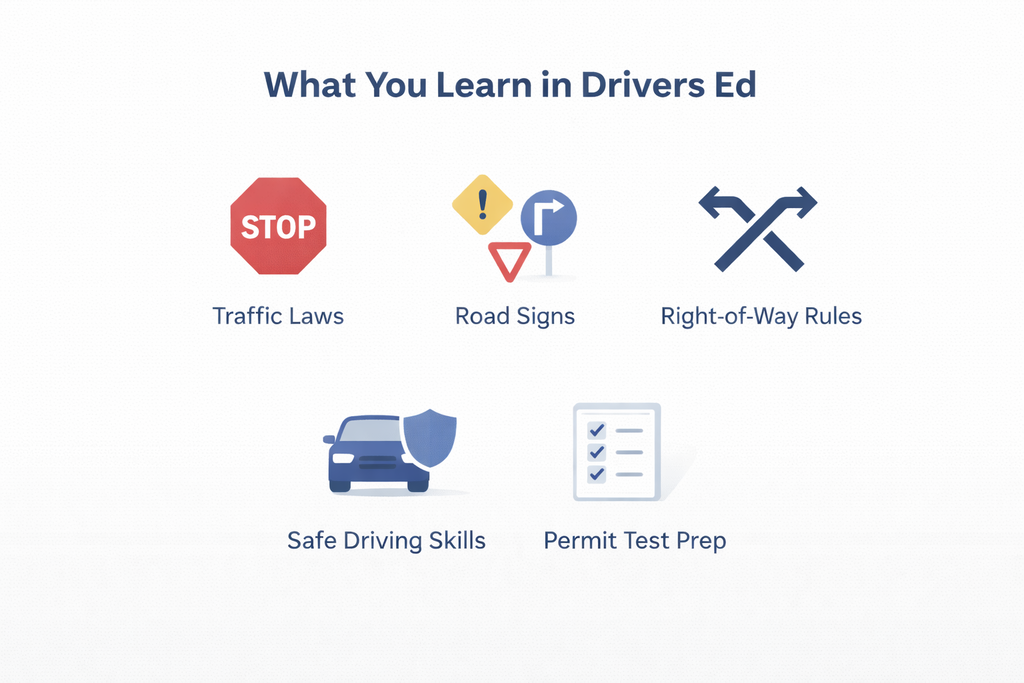
What You Learn in Drivers Ed
drivers ed study guide
State requirements set the content framework, but the core categories are consistent across programs. Every approved course covers the same foundational areas before a student can receive a completion certificate.
Common Drivers Ed Questions and Topics
What does drivers ed teach you? The curriculum covers traffic laws, right-of-way rules, speed limits, the effects of alcohol and drugs on driving ability, and state-specific regulations. Distracted driving, pedestrian safety, and railroad crossing procedures are standard inclusions. Most programs also include practice permit tests – a direct preparation tool for the written DMV exam that follows course completion.
Road Rules, Signs, and Safe Driving Skills
Road sign recognition, lane discipline, intersection procedures, and hazard awareness are the practical skill categories every program addresses. The written DMV permit test draws directly from the same content covered in drivers ed – students who complete the course arrive at the DMV having already worked through the material the test covers. That overlap is one of the reasons completion rates on the first permit test attempt are higher among students who finished a formal program.
How Long Is Drivers Ed
Duration is set by state law, not by the provider. Each state defines a minimum number of instructional hours, and approved programs must meet that threshold before issuing a completion certificate.
How to do drivers ed online means splitting the required hours across multiple sessions – a student with a 30-hour requirement can complete the course over several weeks without losing progress. ETS courses are self-paced with no timers, and the program picks up exactly where the student left off.
Required hours vary significantly by state. California and Oregon both require 30 hours ($29.99 and $49.00 respectively). Idaho sets the same 30-hour requirement at $99.00. Florida's program runs 6 hours at $20.00. The variation reflects each state's licensing framework – shorter programs typically apply to states with separate in-car training requirements handled outside the online course.
Who Needs Drivers Ed
Requirements vary by state and by the age of the applicant. The rules for a 15-year-old in California differ from those for a 22-year-old moving from another country – both may need a program, but for different reasons.
Requirements for Teen Drivers
Do you need drivers ed to get your license as a teen? In most states, yes. Completion of a state-approved drivers ed program is a prerequisite for applying for a learner's permit or a full license if the applicant is under 18. The course produces a completion certificate that the student brings to the DMV along with the permit application. ETS Driver Ed courses target teens aged 15-17, with enrollment typically beginning around age 15 – early enough to complete the required hours before the permit application window opens.
When Adults May Need Driver Education
Adults are not always exempt. Drivers moving from another country, applicants reinstating a suspended license, and first-time adult licensees in certain states may be required or strongly advised to complete a driver education program before testing. Some states waive the drivers ed requirement for applicants over 18 but still require a written knowledge test and a road skills test – meaning the underlying content remains relevant even without a formal course mandate.
How Drivers Ed Helps You Become a Safer Driver
New drivers who complete a formal program enter the road with a baseline of traffic law knowledge and hazard awareness that untrained drivers lack. NHTSA research shows that formal driver education reduces early crash involvement among teen drivers compared to self-taught preparation – the difference shows up in the first year of independent driving, when crash rates are highest.
What is drivers ed developing, specifically? A decision-making framework. The course does not just deliver facts about speed limits and road signs – it trains students to recognize developing hazards, understand right-of-way conflicts, and respond to road conditions before they become emergencies. That framework is what carries over from the screen to the road.
For drivers who want to build on that foundation, ETS offers a driver ed course across multiple states – 100% online, self-paced, DMV-licensed, with a completion certificate delivered upon finishing.
Conclusion
What is drivers ed at its core – a state-approved program that gives new drivers the knowledge and habits they need before driving independently. The content covers traffic laws, road signs, hazard recognition, and state-specific rules. Completion satisfies the DMV requirement for a learner's permit in most states and produces a measurable reduction in early crash involvement.
Driver education is not a formality. It is the structured preparation that bridges the gap between knowing the rules exist and knowing how to apply them on a road shared with other drivers.
ETS Driver Ed courses are 100% online, self-paced, and DMV-licensed – a direct next step for any new driver ready to start the licensing process.
FAQs
Is drivers ed required in every state?
No. Requirements vary by state and applicant age. Most states require a state-approved program for drivers under 18 before issuing a learner's permit or license. Some states waive the requirement for adults over 18 but still require a written knowledge test and road skills test before licensing.
Can you skip drivers ed if you are over 18?
In many states, yes. Adults applying for a first license are often exempt from the drivers ed requirement, though they still need to pass a written knowledge test and a road skills test. Some states and specific circumstances – such as license reinstatement – may still require a formal program.
How many tests are in drivers ed?
Most programs include a quiz at the end of each module and a final exam at the end of the course. The number of module quizzes depends on how many modules the course contains. ETS courses allow free retakes on the final exam, so students can complete the program without a hard cutoff on attempts.
Can you fail drivers ed and retake it?
Yes. Most programs allow students to retake quizzes and the final exam as needed. Online programs typically offer unlimited retakes, meaning a student who does not pass on the first attempt can review the material and try again without restarting the entire course.
Is drivers ed different from defensive driving?
Yes. Drivers ed is designed for new drivers working toward a first license – it covers foundational traffic law, road signs, and permit test preparation. Defensive driving courses target licensed drivers seeking point reduction, ticket dismissal, or an insurance discount. The content overlaps in some areas, but the purpose and eligibility requirements are different.


