What to Do If You Get a Traffic Ticket

A traffic ticket is not just a fine – it is a legal document with a deadline. Knowing what to do after a speeding ticket starts with reading the citation carefully: the response date is printed on it, and that window is typically 30 days from the date of issue. Miss it, and the court may enter an automatic guilty finding, add fees on top of the original fine, and place a hold on the license. For drivers who received a moving violation, traffic school for speeding ticket is one of the options that satisfies the court requirement while keeping points off the record – but eligibility must be confirmed before enrolling. Understanding how traffic school for speeding ticket fits into the available options is what this guide covers.
What Happens If You Get a Traffic Ticket
What happens if you get a traffic ticket depends on what you do next. The citation creates a legal obligation – the driver must respond by the deadline listed on the ticket, either by paying the fine, contesting it, or enrolling in an approved course where eligible.
Ignoring the ticket is not a neutral choice. An unanswered citation can result in a failure to appear charge, an automatic guilty finding entered by the court, and a DMV hold on the driver's license. At that point, resolving the original violation requires additional fees and a separate process to lift the hold – a significantly more complicated outcome than responding on time.
The type of violation on the ticket determines which options are available. Not all citations qualify for traffic school, and not all of them add points to the driving record.
Types of Violations and Why They Matter
The violation type printed on the citation determines which response options are available and whether the ticket will add points to the driving record.
What Is a Moving Traffic Violation
A moving traffic violation occurs while the vehicle is in motion. Speeding, running a red light, failure to yield, illegal lane changes – all of these happen while the car is being driven, and all of them add points to the driving record when processed by the DMV.
Not every citation works the same way. Expired registration is a vehicle status issue, not a driving behavior – it is classified as a non-moving violation and does not add points. Seatbelt tickets fall into a gray area: most states treat them as non-moving violations, but classification varies by jurisdiction. An accident is not automatically a moving violation either – the moving violation is the citation issued for the behavior that caused it, such as speeding or failure to yield.
The distinction matters because traffic school eligibility, point reduction options, and insurance impact all flow from the violation category. A non-moving violation typically resolves with a fine payment and no further consequences for the driving record.
Your Main Options After Receiving a Traffic Ticket
Three responses are available after a citation is issued. Each carries different consequences for the driving record, insurance premiums, and the driver's legal standing with the court.
Pay the Ticket and Accept the Consequences
Paying the fine closes the case but enters a guilty plea on the driver's record. Points are applied automatically, the violation becomes part of the driving history reported to insurers, and the premium impact follows at the next renewal. A paid speeding ticket raises insurance premiums by 20-25% on average and stays on the policy for three to five years.
For a driver with a clean record and no traffic school eligibility, paying is often the fastest resolution. For a driver with existing points, it is the option that carries the most long-term cost.
Fight the Ticket in Court
Contesting the citation requests a formal hearing where the driver enters a not-guilty plea. Is it worth fighting a traffic ticket? It depends on the circumstances – a borderline violation, unclear evidence, or a first offense on an otherwise clean record are all situations where contesting makes sense. A successful challenge keeps the violation off the record entirely.
The process varies by jurisdiction. Many courts allow the contest to be submitted online, by mail, or in person. One practical detail: if the issuing officer does not appear at the scheduled hearing, many jurisdictions enter an automatic dismissal.
Take Traffic School for Tickets
Traffic school for tickets is the option that satisfies the court requirement while preventing points from appearing on the driving record in eligible cases. The ticket fine is typically still paid, but the violation does not enter the public driving record – meaning the insurance impact is avoided.
This option requires court or DMV approval before enrollment. Completing a course without prior authorization does not guarantee point prevention, regardless of which course the driver takes.
Traffic School Eligibility and Benefits
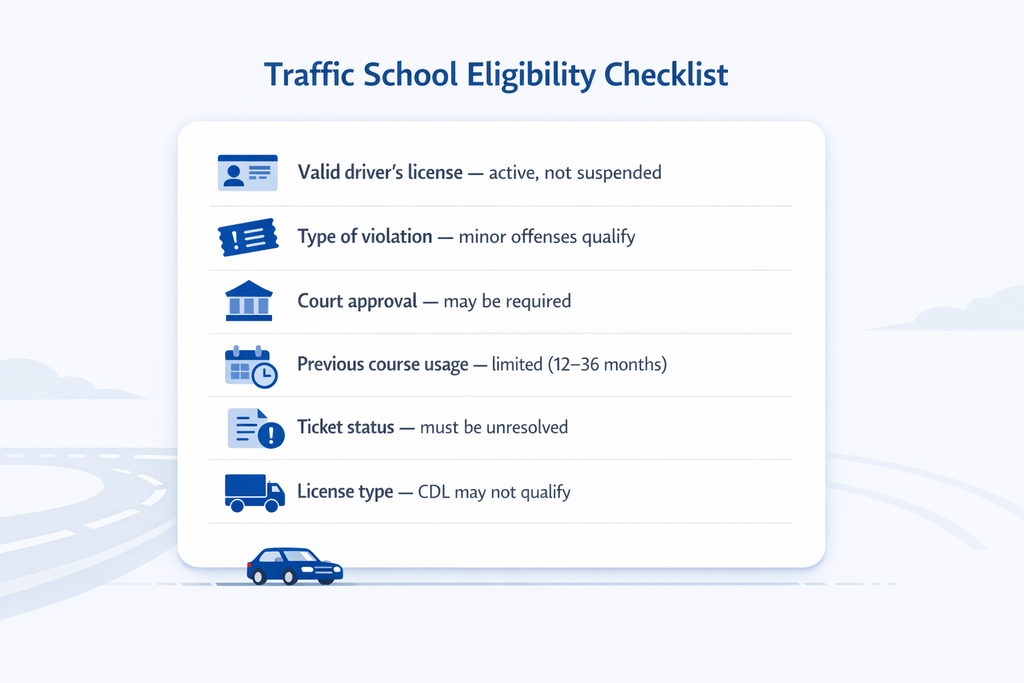
traffic school eligibility
Traffic school eligibility is not automatic. The court or DMV determines whether a driver qualifies based on the violation type, the driver's recent course history, and state-specific rules. A driver who used traffic school within the last 12 to 36 months – the window varies by state – may not qualify again for a new violation until the waiting period resets.
The benefits of traffic school come down to three outcomes in a single step: the court requirement is satisfied, points are kept off the driving record, and the insurance impact of the violation is avoided. For a first-time speeding ticket on an otherwise clean record, that combination makes traffic school the most cost-effective response available.
ETS offers state-approved Traffic School Courses across all 50 states – 100% online, self-paced, no timers, with free instant DMV and court submission upon completion. Drivers confirm eligibility with their court or DMV before enrolling, and ETS handles the reporting automatically once the course is finished.
How to Decide What to Do After a Traffic Ticket
The decision comes down to four variables: the violation type, the current record, eligibility for traffic school, and whether the ticket is worth contesting.
For a first-time moving violation on a clean record, traffic school for speeding ticket is typically the most cost-effective path – it satisfies the court, prevents points, and avoids the insurance increase that follows a paid violation. The total cost is the fine plus the course fee, but the three-to-five-year premium impact is avoided entirely.
Drivers with existing points on their record have more at stake. Another point addition moves them closer to the suspension threshold, which makes traffic school or a successful court challenge a higher priority than for a driver with no prior violations.
Contesting makes sense when the violation is borderline or the evidence is unclear. Paying outright makes sense when eligibility for traffic school is ruled out and the violation is minor enough that the record impact is limited.
Deadlines: How Long to Pay a Traffic Ticket and Respond
Knowing how long to pay a traffic ticket matters as much as knowing which option to choose. Most states set a 30-day response window from the citation date – that deadline applies equally to paying the fine, submitting a contest, and enrolling in a traffic school course.
The clock runs from the issue date on the ticket, not from when the driver decides to act. A driver who spends two weeks researching options and then misses the deadline faces the same consequences as one who ignored the ticket entirely – additional fines, a potential failure to appear charge, and a DMV hold on the license.
For traffic school, the deadline is especially important. Many courts require enrollment and completion within the response window. A driver who confirms eligibility but delays enrollment may find the court deadline has passed before the course is finished – which removes the point prevention benefit even if the course was completed.
Conclusion
A traffic ticket requires a response – and the quality of that response determines whether the violation adds points, raises insurance premiums, or disappears from the public record entirely. Traffic school for speeding ticket is the option that produces the best outcome for eligible drivers: the court requirement is satisfied, points are prevented, and the insurance impact is avoided. The window to act is typically 30 days, and every option – paying, contesting, or enrolling in a course – closes when that deadline passes.
Delays cost options. A driver who confirms eligibility and acts within the response window has more control over the outcome than one who waits until the deadline is close.
ETS offers state-approved online courses across all 50 states – self-paced, 100% online, with free instant DMV and court submission and support available 24/7.
FAQs
How long do you have to respond to a traffic ticket?
Most states set a 30-day response window from the citation date. The deadline applies to all responses – paying the fine, contesting the ticket, and enrolling in traffic school. Missing it can result in additional fines, an automatic guilty finding, and a DMV hold on the license.
Can traffic school keep points off your record after a speeding ticket?
Yes, in states where the driver is eligible. Completing a state-approved course after a speeding ticket can prevent points from appearing on the public driving record. Eligibility depends on the violation type, prior course usage, and court approval – drivers must confirm before enrolling.
What happens if you ignore a traffic ticket?
An unanswered ticket can result in a failure to appear charge, an automatic guilty finding, additional fines, and a DMV hold on the driver's license. Resolving it after the deadline requires addressing both the original violation and the additional consequences separately.
Can you fight a traffic ticket without going to court in person?
Yes. Many jurisdictions allow drivers to contest a citation online, by mail, or by phone. The process varies by state and court – the citation itself typically includes instructions for how to submit a not-guilty plea without appearing in person.
Does every traffic ticket count as a moving violation?
No. Moving violations occur while the vehicle is in motion – speeding, running a red light, failure to yield. Parking tickets, expired registration, and most equipment violations are non-moving violations. The distinction determines whether points are added to the driving record and whether traffic school eligibility applies.


