Distracted Driving: Definition, Facts, and Safety Risks

Every year, distracted driving kills thousands of people on U.S. roads. In 2022 alone, it claimed 3,308 lives – and that number only counts reported cases. Distracted driving means any activity that pulls a driver's attention away from the road, whether for two seconds or twenty. The problem is not limited to phones. Eating, adjusting the GPS, or simply losing focus all count. At 55 mph, taking your eyes off the road for just five seconds means traveling the full length of a football field without looking. That is the scale of risk distracted driving creates on every trip.
What Is Distracted Driving
The term covers a much wider range of behaviors than most drivers expect. Phone use gets the most attention, but the definition of distracted driving applies to any action that takes focus, hands, or eyes away from the task of driving.
Why Distracted Driving Is More Than Just Texting
What is distracted driving in practical terms? Texting is the most-cited example because it is visible and measurable. But the behavior behind the wheel that causes crashes is far broader – eating a sandwich at a red light, arguing with a passenger, or mentally replaying a conversation while the road ahead changes all qualify.
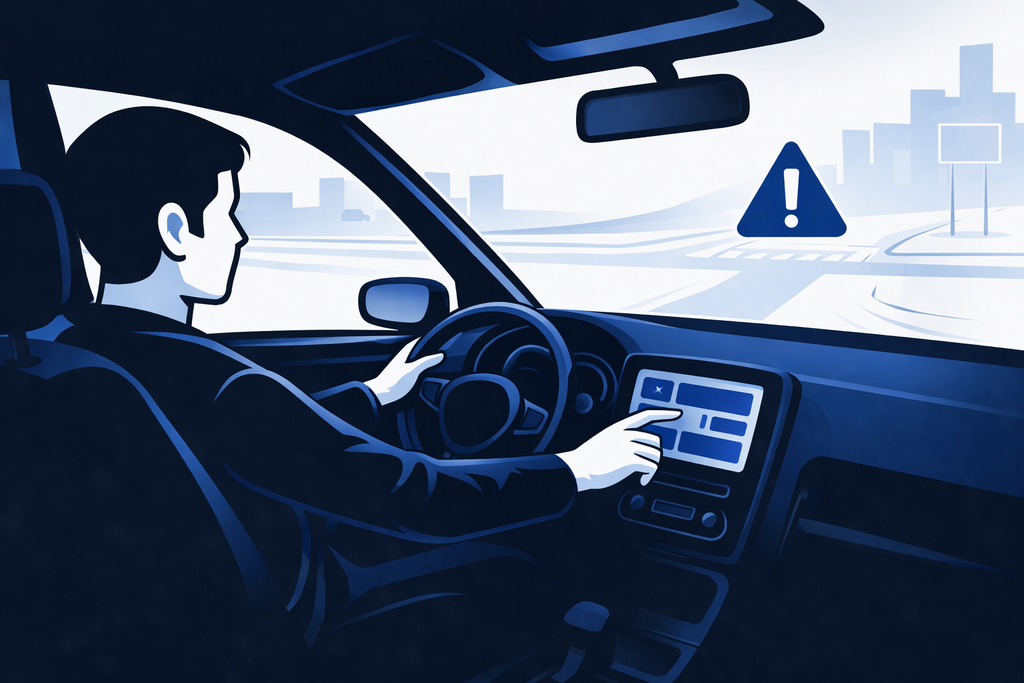
What is the definition of distracted driving? Any action that creates a gap between where a driver's attention is and where it needs to be. Cognitive distraction is the hardest category to recognize. A driver can have both hands on the wheel and eyes pointed forward while still processing almost nothing about the traffic around them. That gap is what makes distracted driving difficult to self-report – the behavior often leaves no visible trace until something goes wrong.
Main Types of Distracted Driving
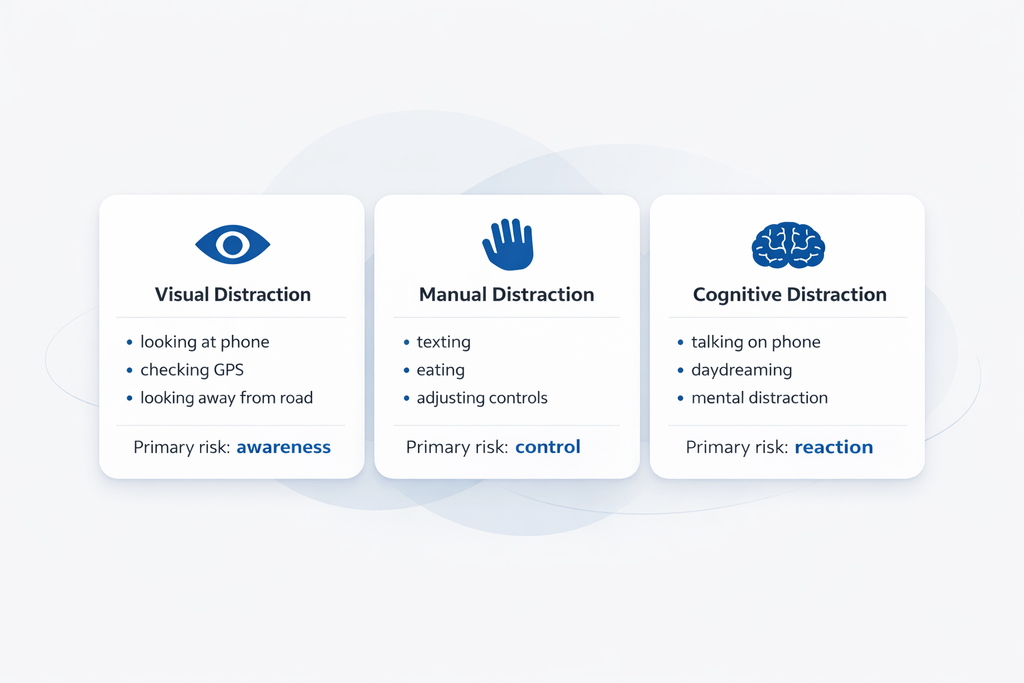
The CDC organizes driver distraction into three categories. Each one removes a different resource from the driving task, and some behaviors trigger more than one category at the same time.
Visual, Manual, and Cognitive Distractions
distracted driving facts
Visual distraction means the driver's eyes leave the road. Manual distraction means one or both hands leave the wheel. Cognitive distraction means the driver's mind disengages from the act of driving – even if eyes and hands are technically in position.
Texting while driving hits all three simultaneously. That combination is what makes it the highest-risk single behavior behind the wheel. Distracted driving in any one category increases crash risk, but the overlap between categories is where the most serious incidents occur.
One detail that surprises many drivers: cognitive distraction does not end when the distracting activity stops. Research from AAA found that the mental load from a hands-free phone call persists for up to 27 seconds after the call ends – meaning a driver can still be cognitively impaired while approaching an intersection they believe they are fully focused on.
Common Examples of Distracted Driving
The most common sources of distracted driving go beyond phones. Eating or drinking while driving requires at least one hand off the wheel and periodic attention to the food rather than the road. Grooming – applying makeup, checking appearance in the mirror – pulls both visual and manual focus. Interacting with in-vehicle technology, including navigation systems and entertainment screens, is particularly underestimated.
According to AAA Foundation research, adjusting in-vehicle technology takes a driver's eyes off the road for an average of 40 seconds. At highway speed, that is enough time to cover more than half a mile without meaningful visual contact with the road ahead.
Why Distracted Driving Is Dangerous
what is the definition of distracted driving
Distraction does not degrade just one driving function – it affects perception, decision-making, and physical response at the same time. The result is a driver who may feel in control while operating significantly below the level the road requires.
How Distraction Affects Reaction Time and Awareness
Reaction time is one of the most measurable effects. A driver who is texting reacts to hazards 23% slower than a driver who is legally drunk, according to a Car and Driver study. At 60 mph, a one-second delay in braking adds 88 feet to the stopping distance before the vehicle even begins to slow down.
Distracted driving also compresses the area of the road a driver actually processes. Eye-tracking research shows that distracted drivers tend to fixate on a narrow central zone and miss activity in their peripheral field – lane drifts, merging vehicles, pedestrians stepping off curbs. The eyes may be open and directed forward, but the brain is not registering what they see.
Why Small Habits Lead to Serious Driving Errors
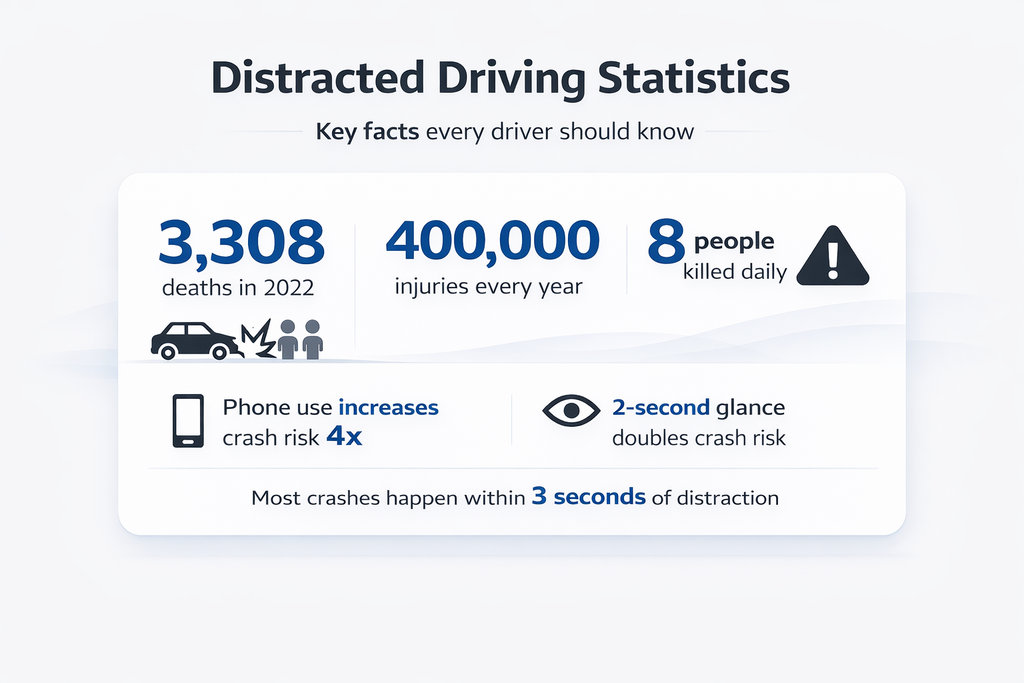
The behaviors that cause the most crashes are often the ones drivers consider low-risk. Glancing at a phone for two seconds feels brief. Research from NHTSA and the Virginia Tech Transportation Institute found that a two-second glance doubles the risk of a crash or near-crash event.
Most distracted driving incidents happen fast. The majority of distraction-related crashes occur within three seconds of the distracting event – not after prolonged inattention, but after a single moment of divided focus. That timeline is what makes the habit of checking a phone at a red light, or briefly looking at a passenger while speaking, more dangerous than it feels in the moment.
Distracted Driving Statistics and Facts
Federal agencies track distraction-related crashes separately from other accident categories. The data covers fatalities, injuries, and behavioral patterns across all driver age groups – and the numbers have remained consistently high for over a decade.
Distracted Driving Statistics Drivers Should Know
distracted driving statistics
Distracted driving statistics from NHTSA show 3,308 deaths in 2022 – a figure that excludes incidents where distraction was suspected but not confirmed. Approximately 400,000 people are injured in distraction-related crashes every year in the United States. The CDC puts the daily death toll at 8 people killed per day. Drivers who use a phone behind the wheel are four times more likely to be involved in a crash, according to the World Health Organization.
These distracted driving statistics apply across vehicle types and road conditions. The majority of incidents do not happen on highways at high speed – they happen on familiar local roads where drivers feel comfortable and let their attention drift.
Distracted Driving Facts That Show the Real Risk
Several distracted driving facts stand out when looking at who bears the consequences. Twenty percent of people killed in distraction-related crashes are not the driver – they are passengers, pedestrians, or occupants of other vehicles. Interactions with touchscreens and in-vehicle displays increase crash risk by three times compared to driving with no secondary task, according to NHTSA.
Two more distracted driving facts that reflect how underestimated the problem is: distraction was reported as a factor in 8% of all fatal crashes in 2022, but researchers estimate the actual share is higher because distraction is frequently underreported at crash scenes. Teen drivers are disproportionately represented in distraction-related fatality data, but drivers in their 20s account for the largest share of distracted driving deaths overall.
Distracted Driving Accidents and Their Consequences
Distracted driving accidents carry consequences that extend well beyond the crash itself. On the legal side, most states treat distracted driving as a moving violation – fines range from $50 to over $500 depending on the state and whether it is a repeat offense. Points are added to the driver's record, and accumulating points within a set period can trigger license suspension.
The financial impact compounds over time. An at-fault distracted driving accident typically raises insurance premiums significantly, and that increase stays on the policy for three to five years. In cases where another person is injured, the driver may also face civil liability – meaning a lawsuit for damages separate from any criminal or traffic penalties.
Several states have moved beyond treating distraction as a minor infraction. In cases where distracted driving causes serious bodily injury or death, prosecutors in states including California, New York, and Texas have pursued criminal charges including vehicular manslaughter. A momentary lapse in attention can carry the same legal weight as other forms of reckless driving.
The consequences also reach people who were not behind the wheel. As noted earlier, 20% of distraction-related fatalities involve pedestrians, cyclists, or passengers – people who had no part in the decision to drive distracted.
Understanding the risks is the first step toward changing habits behind the wheel. ETS offers state-approved online courses across all 50 states – 100% online, self-paced, with free instant DMV and court submission upon completion.
How to Prevent Distracted Driving
Most distractions behind the wheel are controllable. The habits that reduce distracted driving risk are not complicated – they require a decision made before the trip starts, not during it.
Putting the phone on Do Not Disturb before pulling out of the driveway removes the temptation to respond to notifications mid-drive. Research shows that Do Not Disturb mode reduces phone interactions while driving by 3.5 times. Mounting the phone and setting the destination in the GPS before moving eliminates the need to interact with the screen while the vehicle is in motion.
Passengers can be managed too. Letting people in the car know that conversations will pause in heavy traffic or complex driving situations is a straightforward way to reduce cognitive load at the moments it matters most.
Eating, grooming, and other tasks that feel minor are better handled before getting in the car. A two-minute stop before a long drive is a lower cost than the alternative.
For drivers who want a structured approach to recognizing and managing distraction, a defensive driving course covers real-world risk awareness with state-approved content – available online, self-paced, across all 50 states.
Conclusion
Distracted driving is not an edge case – it is one of the most common factors in crashes that happen on ordinary roads, during ordinary trips. The definition is broad, the risk is measurable, and the behaviors that cause serious accidents are ones most drivers engage in regularly without recognizing the exposure.
Awareness changes the calculation. Knowing that a two-second glance doubles crash risk, or that cognitive distraction outlasts the activity that caused it, gives drivers a concrete basis for different decisions behind the wheel.
ETS courses are available in all 50 states, 100% online and self-paced, with free instant DMV and court submission upon completion. For drivers who want to move from awareness to structured habit-building, that is a practical next step.
FAQs
Is eating or drinking while driving considered distracted driving?
Yes. Eating while driving is a manual and visual distraction – it takes at least one hand off the wheel and pulls attention away from the road periodically. Most states do not have a specific law against it, but it still increases crash risk and can be cited as a contributing factor in an accident.
Are hands-free devices completely safe to use while driving?
No. Hands-free devices eliminate manual distraction but not cognitive distraction. The mental load of a phone conversation continues regardless of how the phone is held. AAA research found that cognitive impairment from a call persists for up to 27 seconds after the conversation ends.
Can passengers be a source of driver distraction?
Yes. Passengers create both cognitive and visual distraction – drivers tend to make eye contact during conversation, which takes their eyes off the road. Adult passengers generally adjust their behavior when driving conditions change, but younger passengers, particularly other teens, are associated with higher distraction risk.
Does distracted driving affect insurance rates?
Yes. A distracted driving violation adds points to the driver's record, which insurers use to calculate premiums. An at-fault accident involving distraction raises rates further and typically affects the policy for three to five years.
What penalties can repeat distracted driving violations lead to?
Repeat violations result in escalating fines, increased points on the driving record, and in some states, mandatory completion of a driver improvement course. Accumulating points beyond a state's threshold can trigger license suspension. In cases involving injury or death, repeat offenders face a higher likelihood of criminal charges.


