What Course to Take to Remove Points from Your License

Not every course qualifies for point removal. A driver improvement course online needs to meet two conditions before it counts: it must be approved by the state DMV or court, and it must match the violation type the driver is trying to address. The name on the course – whether it says defensive driving, driver improvement, or traffic school – does not determine eligibility. The state approved defensive driving course status does. Choosing a driver improvement course online without confirming approval first is the most common reason drivers complete a course and see no change to their record.
What Is a Defensive Driving or Driver Improvement Course
Both course types cover traffic law, hazard recognition, and risk management – but they serve different purposes depending on the state and the driver's situation. The distinction matters because states often specify which course type qualifies for point reduction, and substituting one for another can produce no result even if the course itself is completed correctly.
A driver improvement course online is typically tied to a specific violation or DMV requirement. It addresses the behavior behind the citation – aggressive driving, following too closely, repeated minor violations – rather than general safe driving skills. A defensive driving course is broader in scope and more widely accepted across states for standard point reduction or insurance discount purposes.
In some states, completing a course prevents points from being shared with insurance companies rather than removing them from the record entirely. That is a distinct outcome – and one that affects how the completion certificate is used after the course is finished.
Types of Courses That Help Remove Points
The defensive driving course benefits a driver receives depend on which course type applies to their situation. Three categories exist, and each works through a different mechanism.
Defensive Driving Courses
A state approved defensive driving course is the most widely available option for point reduction. Most states accept it for standard violations – speeding, failure to yield, improper lane changes – and the approval comes from the state DMV or court system before the course can be used for any official purpose.
In some states, the insurance benefit after course completion is fixed by law – meaning insurers are required to apply a specific premium reduction for a set period. In others, the discount is left to insurer discretion. The approval status of the course determines which outcome applies.
Driver Improvement Course Online
Driver improvement courses are typically required or recommended after a specific violation – they target the behavior behind the citation rather than general driving skills. Some states mandate an 8-hour driver improvement program for point reduction after certain offenses, while others use a shorter format tied to the violation category.
The course content covers traffic law, hazard recognition, and safe following distance – but is structured around the violation type that triggered the requirement. In states that mandate driver improvement after certain offenses, a standard defensive driving course does not substitute for it.
Online Traffic School for Ticket
Online traffic school for ticket dismissal or point prevention is the option most commonly used immediately after a citation is issued. In some states, completing a basic driver improvement course within a required timeframe prevents points from being added to the record entirely – the mechanism is prevention rather than removal.
The ticket fine is typically still paid, but the violation does not enter the public driving record when the course is completed on time and with prior court authorization.
How to Choose the Best Defensive Driving Course Online
The best defensive driving course online is the one approved by the driver's specific state DMV or court – not the one with the lowest price or the fastest completion time. Approval status is the only variable that determines whether finishing the course produces any change to the driving record.
Three steps narrow the choice down quickly. First, check the citation or contact the court directly to confirm which course types are accepted for the violation in question. Some courts maintain a list of approved providers; others specify only the course category. Second, verify that the course carries active DMV or licensing agency approval for the driver's state – not just a general claim of acceptance. Third, confirm that the course matches the violation category, since some states restrict point reduction eligibility to specific offense types.
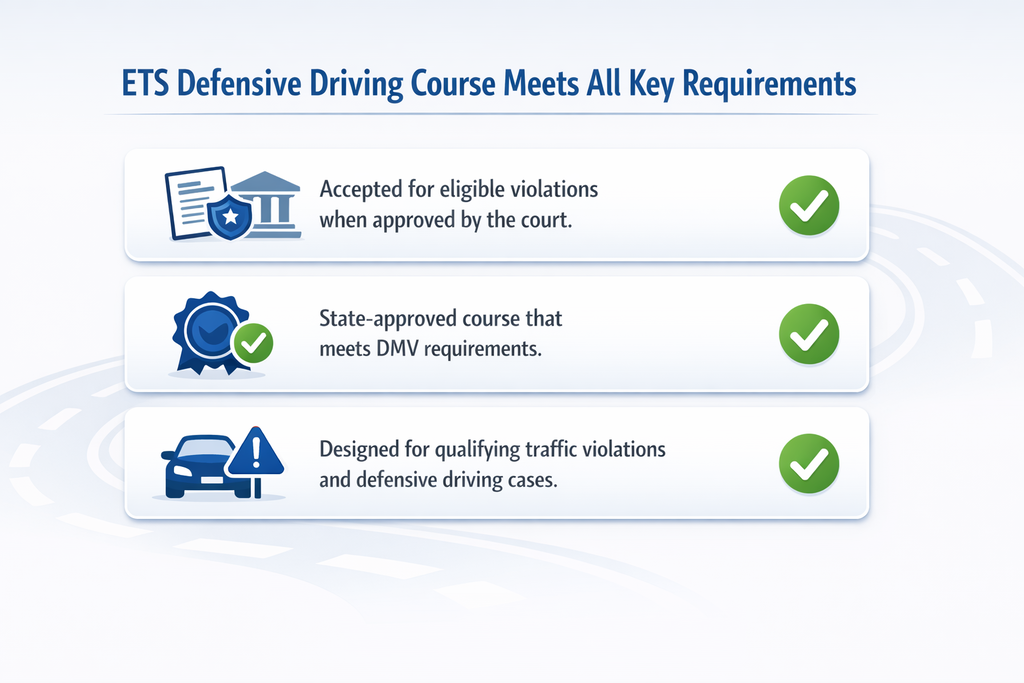
ETS offers a Defensive Driving Course across all 50 states – state-approved, 100% online, self-paced, with free instant DMV and court submission upon completion. The catalog covers durations and pricing set by each state's requirement.
best defensive driving course online
How Long Is a Defensive Driving Course and What to Expect
Course length is set by state law, not by the provider. Each state defines a minimum number of instructional hours, and approved courses must meet that threshold before issuing a completion certificate. The range across states runs from 4 to 8 hours – Arizona requires 4 hours ($38.95), Texas and New York both require 6 hours ($29.00 each), California and Virginia require 8 hours ($27.99 and $49.00 respectively).
Because ETS courses are self-paced with no timers, the required hours can be split across multiple sessions. A driver with a 6-hour requirement can complete the course over two evenings or six separate one-hour sessions – progress saves automatically and the course resumes exactly where it stopped.
Content is delivered in modules, each followed by a quiz. A final exam closes the course. The exam can be retaken if needed, and no minimum sitting time is enforced within sessions. Upon completion, ETS submits the certificate directly to the court or DMV – no additional step is required from the driver.
How Often Can You Take Defensive Driving Courses
How often can you take defensive driving courses for point reduction? The answer depends on the state – there is no universal rule that applies across jurisdictions.
Most states set a minimum interval between eligible completions, typically once every 12 to 36 months. A driver who used a course for point reduction 10 months ago cannot use it again for a new violation until the waiting period resets. The frequency limit applies to the driver's eligibility, not to the course itself – the same driver can retake the course, but the completion will not count toward point reduction until the interval has passed.
Some states use a longer window. Georgia allows up to 7 points removed every 5 years through a certified 6-hour Driver Improvement course – a longer interval but a higher point reduction ceiling than most states offer. The variation across states means a driver moving from one state to another may find the rules have changed entirely.
Confirming the frequency rule with the court or DMV before enrolling is the only way to know whether a completion will count. ETS courses meet state requirements where approved – but the driver's eligibility window is determined by state law, not by the provider.
Step-by-Step: How to Complete a Course and Remove Points
The process for completing a driver improvement course online and having points removed follows a fixed sequence. Skipping the eligibility confirmation step before enrolling is the most common reason drivers finish a course and see no record change.
Start by pulling the current driving record from the state DMV. Most states provide online access – the record shows which violations are adding points, when they were issued, and whether any prior course completions are on file. That information determines which options are currently available.
Next, contact the court listed on the citation or the state DMV directly. Confirm that the violation qualifies for point reduction through a course, that the driver has not exceeded the frequency limit, and that the court deadline has not passed. Get the list of approved course providers for the state.
Once eligibility is confirmed, enroll in a state-approved course and complete it before the court deadline. ETS courses are self-paced – sessions can be split across multiple days without losing progress. Upon completion, ETS submits the certificate directly to the court or DMV automatically, with most completions reported within 1-3 business days. No additional step is required from the driver after finishing the course.
State Requirements for Course Approval
State approval requirements vary significantly – the same course name does not carry the same approval status in every jurisdiction. A defensive driving course accepted in one state may not qualify in another, even if the content is identical.
Tennessee allows drivers to remove 5 points from their record for a speeding conviction by completing a 4-hour defensive driving course. Florida's Basic Driver Improvement course prevents points from being added if taken within a specific timeframe after the citation – the mechanism is prevention, not removal. In Georgia, a certified 6-hour Driver Improvement course removes up to 7 points every 5 years. Some states, including Michigan, use driver improvement courses primarily to prevent points from reaching insurance companies rather than removing them from the record entirely.
The approval process itself varies too. Some states approve courses at the DMV level – meaning any court in the state accepts the completion. Others require court-specific approval, meaning a course accepted in one county may not be accepted in another within the same state.
Drivers must verify approval with their specific court or DMV before enrolling. ETS courses meet state requirements where approved, and the course catalog covers all 50 states – but eligibility confirmation remains the driver's responsibility before starting.
Conclusion
A driver improvement course online removes points from a license when three conditions are met: the course is state-approved, it matches the violation type, and it is completed within the court's eligibility window. The course name matters less than the approval status – defensive driving, driver improvement, and traffic school all refer to programs that may or may not qualify depending on the state and the specific citation.
State rules vary on frequency limits, point reduction amounts, and which violations qualify. Confirming those rules before enrolling is the step that determines whether the course produces a result.
ETS offers state-approved courses across all 50 states – 100% online, self-paced, with free instant DMV and court submission and support available 24/7.
FAQs
How long is defensive driving course completion usually valid after finishing it?
The completion certificate does not expire, but the benefits tied to it do. Insurance discounts typically apply for three to five years. Point reduction is applied at the time of completion. Drivers who want to renew an insurance discount after the benefit period ends can take the course again when the frequency limit resets.
Can you take a driver improvement course online more than once?
Yes, but the point reduction benefit only applies within the state's frequency window – typically once every 12 to 36 months. Completing the course outside that window does not count toward point removal. The course itself can be retaken at any time; eligibility for the benefit is what resets on a schedule.
Do all courts accept online traffic school for ticket dismissal?
No. Acceptance depends on whether the course carries approval from the specific court or state DMV. Some courts maintain a list of approved providers; others specify only the course category. Drivers should confirm with their court before enrolling that an online course satisfies their specific requirement.
Can you choose any driver improvement course or must it match your violation?
In many states, the course must match the violation category or meet the court's specific approval conditions. A general defensive driving course does not always substitute for a court-mandated driver improvement program. Confirming the requirement with the court or DMV before enrolling is the only way to ensure the completion will count.
Will completing a course remove points immediately or does it take time to update your record?
It takes time. After course completion, the provider submits the certificate to the court or DMV, and the record update follows once processing is complete. ETS reports completions within 1-3 business days. The full record update may take additional time depending on the state's DMV processing schedule.


