Defensive Driving: Definition, Rules, and Benefits

Most drivers react to hazards. What is defensive driving and why does it matter? It is a set of skills and habits that reduce crash risk by preparing a driver for conditions they did not create: other drivers' errors, sudden road hazards, and unpredictable situations. NHTSA estimates that 94% of serious crashes involve human error. The defensive driving definition starts there – with the recognition that controlling your own vehicle is only part of the task. Understanding what defensive driving means in practice is what separates drivers who avoid incidents from those who cause them. Courses built around these skills are accepted across all 50 states for point reduction and insurance discount purposes.
What Is Defensive Driving
Defensive driving means operating a vehicle with enough awareness and control to respond to other drivers' mistakes, not just your own. The defensive driving definition covers a range of behaviors – scanning intersections before entering, maintaining buffer space, adjusting speed to road conditions – that individually seem minor but collectively reduce crash probability.
One of the most widely used frameworks in driver training is the Smith System, developed originally for commercial vehicle operators. It identifies five core habits: aim high when steering, get the big picture, keep your eyes moving, leave yourself an out, and make sure others see you. Each habit addresses a specific gap between where most drivers focus and where attention actually needs to be.
What is defensive driving in road terms? It is the difference between a driver who notices a vehicle drifting two lanes over and one who does not until the lanes meet.
Key Rules of Defensive Driving
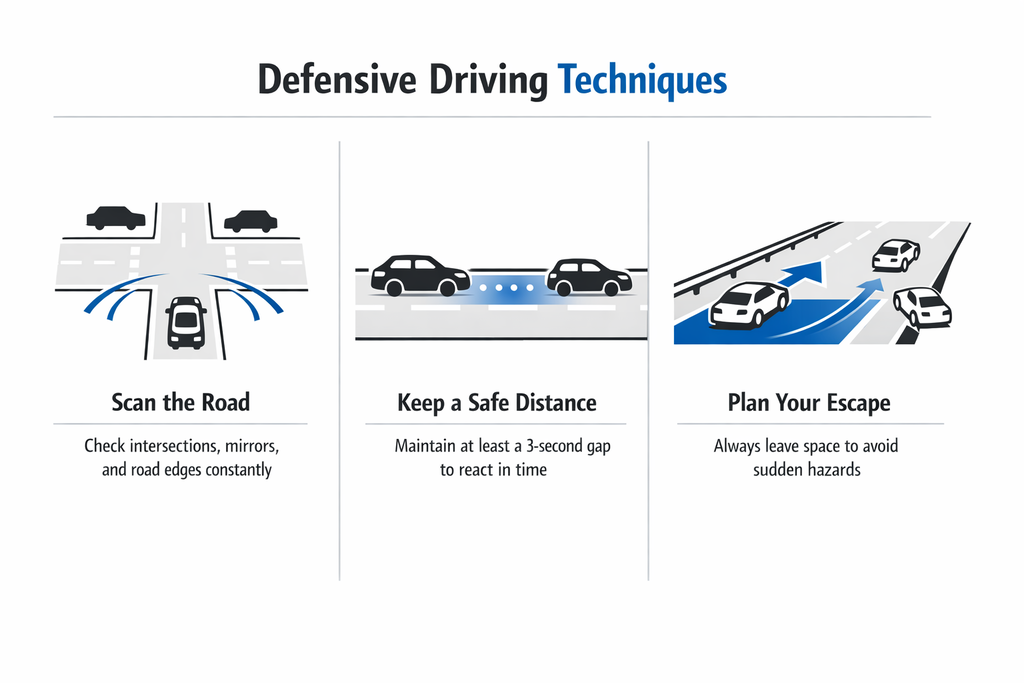
defensive driving techniques
Defensive driving techniques are not situation-specific – they apply on city streets, highways, and rural roads equally. The rules below cover the three behavioral categories that account for the largest share of preventable crashes.
One of the Rules of Defensive Driving Is Staying Alert
One of the rules of defensive driving is active scanning – not passive watching. A driver who checks mirrors every 5-8 seconds, looks ahead to the next intersection, and monitors road edges is processing significantly more information than one whose eyes stay fixed on the vehicle ahead.
At a green light, the defensive driver checks cross-traffic before accelerating. That habit takes under two seconds and directly addresses one of the most dangerous assumptions in driving – that a green light means the intersection is clear. Intersection crashes account for roughly 40% of all traffic crashes in the U.S., according to NHTSA data.
Maintaining Safe Distance and Speed Control
Following distance gives a driver time to react before a situation becomes a collision. The 3-second rule – maintaining a gap that takes at least 3 seconds to close at current speed – translates to approximately 286 feet of buffer at 65 mph. That distance converts speed into reaction time.
Rear-end crashes are the most common crash type in the U.S., making up 29% of all crashes according to NHTSA. The majority involve insufficient following distance, not driver impairment or mechanical failure.
Anticipating Hazards and Driver Behavior
Defensive drivers position themselves on the assumption that other road users will make errors. On a highway with a merging lane ahead, the defensive response is to adjust speed early – either accelerating to create space or slowing to let the merging vehicle in – rather than holding position and forcing a last-second reaction.
Most lane-change crashes involve a failure to check blind spots before moving. A driver who stays out of other vehicles' blind spots and avoids lingering in adjacent lanes reduces exposure to that entire category of error without any interaction with the other driver at all.
Why Defensive Driving Is Important
The case for defensive driving is not built on worst-case scenarios. It is built on the frequency of ordinary errors – following too closely, changing lanes without checking, running a stale yellow light – that occur on every road, every day.
AAA Foundation research found that aggressive driving behaviors, including tailgating, speeding, and failure to yield, are factors in 56% of fatal crashes. Those are not fringe behaviors. They are common, familiar, and often unrecognized as dangerous by the drivers exhibiting them. Defensive driving positions a driver to absorb the consequences of those behaviors without becoming part of the crash.
The practical importance extends beyond personal safety. A driver who avoids at-fault incidents keeps points off their record, maintains lower insurance premiums, and retains full license privileges. Over a decade of driving, the difference between a driver who practices defensive habits and one who does not shows up in renewal rates, surcharges, and court appearances – not just accident history.
What is defensive driving important for, specifically? It addresses the 94% of crashes that involve human error – not road conditions, not vehicle failure, but decisions made behind the wheel.
Benefits of Defensive Driving
The practical outcomes of defensive driving fall into three distinct categories – insurance costs, legal standing, and long-term financial impact. Each works through a different mechanism.
How Defensive Driving Can Lower Insurance Costs
Completing a state-approved course qualifies drivers for an insurance discount in most states. The discount range is typically 5% to 15%, depending on the insurer and the state. Some states mandate that insurers offer the discount after course completion – others leave it to the provider's discretion. Either way, the discount applies for a set period after completion, meaning a single course produces savings across multiple renewal cycles.
Point Reduction and Legal Advantages
In states that allow it, completing a defensive driving course removes points from the driving record or prevents new ones from appearing after a violation. The eligibility rules vary significantly – by state, by violation type, and by how recently the offense occurred. ETS courses are designed to meet court and DMV requirements where approved, but drivers need to confirm eligibility with their court or DMV before enrolling.
Long-Term Safety and Financial Benefits
Fewer at-fault incidents over time produce compounding financial benefits that go beyond any single discount. A single at-fault accident raises insurance premiums by 20-40% and typically stays on the policy for three to five years. Avoiding that event – through the habits defensive driving builds – produces savings that no post-accident discount can replicate.
What Is a Defensive Driving Course
driving defensive course
What is defensive driving course in formal terms? A state-approved program that teaches risk recognition, traffic law, and collision avoidance – reviewed and licensed by the state DMV or court system before it can be used for point reduction or insurance discount purposes.
What to Expect from a Defensive Driving Course
A driving defensive course covers traffic laws, hazard recognition, and risk management, delivered in modules with quizzes at the end of each section. ETS courses are 100% online, self-paced, with no timers – progress saves automatically, and the course works on any device without requiring an app. Drivers can log in and out across multiple sessions, which makes it possible to complete the required hours around a normal schedule.
Upon completion, ETS submits the certificate directly to the court or DMV at no extra cost. The defensive driving course catalog covers all 50 states, with durations and pricing set by state requirement.
Who Should Take a Defensive Driving Course
Three groups of drivers have a direct reason to enroll. Drivers with a recent traffic ticket can use course completion to satisfy court requirements or reduce points, depending on state eligibility. Drivers looking to lower insurance premiums can qualify for a discount through a state-approved program. New drivers building foundational habits benefit from the structured format – the course covers real traffic scenarios, not just written rules.
Eligibility for point reduction or ticket dismissal requires confirmation with the court or DMV before enrolling. ETS courses meet state requirements where approved, but the driver is responsible for verifying that their specific violation and jurisdiction qualify.
ETS offers state-approved online defensive driving courses across all 50 states – 100% online, self-paced, no timers, with free instant DMV and court submission upon completion.
How Long Is a Defensive Driving Course
How long is defensive driving course completion required to take? Each state sets a minimum number of instructional hours, and approved courses must meet that threshold. ETS courses range from 4 to 8 hours depending on the state – Arizona requires 4 hours ($38.95), Texas and New York both require 6 hours ($29.00 each), California requires 8 hours ($27.99), and Florida's basic course runs 4 hours ($5.94).
Because ETS courses are self-paced with no timers, the required hours can be split across multiple sessions. A driver with a 6-hour requirement can complete two 3-hour sessions on separate days, or six 1-hour sessions across a week. The course picks up exactly where the driver left off.
How Much Defensive Driving Lowers Insurance
No single figure applies across all states and insurers. The discount a driver receives after completing a state-approved course depends on the insurance provider, the state's requirements, and whether the discount is mandated or optional under state law.
The typical range runs from 5% to 15% off liability and collision premiums. In New York, the Point & Insurance Reduction Program (PIRP) mandates a 10% reduction on liability and collision coverage for three years following course completion – one of the few states where the discount amount and duration are fixed by law rather than left to insurer discretion. The ETS New York Defensive Driving Course meets PIRP requirements at $29.00 for the DMV-required 6 hours.
In states without a mandated rate, drivers should confirm the discount amount directly with their insurer before enrolling. The course completion certificate is what triggers the discount – ETS submits it to the court or DMV automatically upon completion.
Conclusion
Defensive driving is a defined set of behaviors with measurable outcomes. It reduces crash probability, keeps points off driving records, and produces insurance savings that compound over years of driving. The skills it builds – sustained alertness, safe following distance, hazard anticipation – apply on every trip, regardless of road type or conditions.
Over time, defensive driving means fewer incidents, lower premiums, and a cleaner record – a consistent pattern across federal crash data and insurance industry research. That is not a guarantee, but it is what the data shows across driver groups and road conditions.
ETS state-approved courses are available online across all 50 states – self-paced, no timers, free instant DMV and court submission upon completion. Find the course for your state and start today.
FAQs
Can defensive driving skills be learned without a course?
Yes. Drivers can develop defensive habits through practice and self-study. A structured course accelerates that process by covering hazard recognition, traffic law, and risk management in a format accepted by courts and insurers. Self-study alone does not satisfy court or DMV requirements for point reduction or ticket dismissal.
Is defensive driving required by law in some states?
Not as a general requirement for all drivers. Some states require a defensive driving or driver improvement course as part of a court order following a violation, or as a condition for license reinstatement. Voluntary completion is available in all 50 states for point reduction or insurance discount purposes.
Do defensive driving courses expire after completion?
The completion certificate does not expire, but the benefits tied to it do. Insurance discounts typically apply for three to five years. Point reduction eligibility is applied at the time of completion. Drivers who want to renew an insurance discount after the benefit period ends can take the course again.
Are online defensive driving courses accepted everywhere?
Online courses are accepted in most states for point reduction and insurance discount purposes. Acceptance depends on whether the course is approved by the state DMV or court system. ETS courses meet state requirements where approved – drivers should confirm with their court or DMV that an online course satisfies their specific requirement before enrolling.
Does defensive driving help after a traffic ticket?
In many states, yes. Completing a state-approved course after a violation can result in point reduction, ticket dismissal, or prevention of points appearing on the record, depending on state law and court eligibility. The driver must confirm eligibility with the court before enrolling – completion alone does not guarantee dismissal.


