New Jersey Point System: How NJ MVC Points Work, Surcharges, and How to Remove 2 Points

What is the New Jersey point system? The New Jersey point system is a statewide regulatory framework administered by the New Jersey Motor Vehicle Commission (MVC) to track moving violations and penalize high-risk driving behavior. Under the New Jersey point system, every moving infraction—from speeding along the Garden State Parkway to tailgating on the New Jersey Turnpike—assigns penalty points to your record. Accumulating points triggers costly state-mandated cash surcharges, spikes auto insurance premiums for years, and risks driver license suspension, making it essential for Garden State drivers to understand how points accumulate and how to remove them legally.
How the New Jersey Point System Works
In New Jersey, traffic regulation is governed by Title 39 of the New Jersey Statutes Annotated (N.J.S.A.). Unlike many other states that delegate driver records to an agency named the DMV, New Jersey operates through the New Jersey Motor Vehicle Commission (MVC). Whenever a police officer or New Jersey State Trooper issues a ticket and you pay the fine or are convicted in municipal court, the court clerk notifies the MVC, which records the points on your permanent driving abstract.
Points in New Jersey are assessed strictly for moving violations. Non-moving infractions—such as parking tickets, expired vehicle inspection stickers, or equipment defects—do not carry point penalties. However, once moving violation points post to your record, they remain permanently visible on your historical abstract, even after point reductions reduce your active administrative total.
Common Traffic Violations and Their NJ Point Values
The NJ MVC assigns points according to a standardized schedule established under N.J.A.C. 13:19-10.1. Common point assessments include:
- Speeding 1 to 14 mph over limit (N.J.S.A. 39:4-98): 2 points
- Speeding 15 to 29 mph over limit: 4 points
- Speeding 30 mph or more over limit: 5 points
- Careless Driving (N.J.S.A. 39:4-97): 2 points
- Reckless Driving (N.J.S.A. 39:4-96): 5 points
- Tailgating / Following Too Closely (N.J.S.A. 39:4-89): 5 points
- Failure to Observe Traffic Signals / Red Lights (N.J.S.A. 39:4-81): 2 points
- Improper Passing (N.J.S.A. 39:4-85): 4 points
- Improper Passing of a School Bus (N.J.S.A. 39:4-128.1): 5 points
- Leaving the Scene of an Accident with Personal Injury (N.J.S.A. 39:4-129): 8 points
Understanding these point values is critical because just two minor tickets—such as a 16-mph speeding ticket and an improper turn—can push your record into dangerous penalty territory within minutes.
The Hidden Trap: New Jersey MVC Surcharges
Most motorists believe that paying the municipal court fine closes their financial obligation to the state. In New Jersey, that assumption is false. Beyond court fines and court costs, the state operates a secondary financial penalty program known as New Jersey Surcharges.
The 6-Point Surcharge Trigger Explained
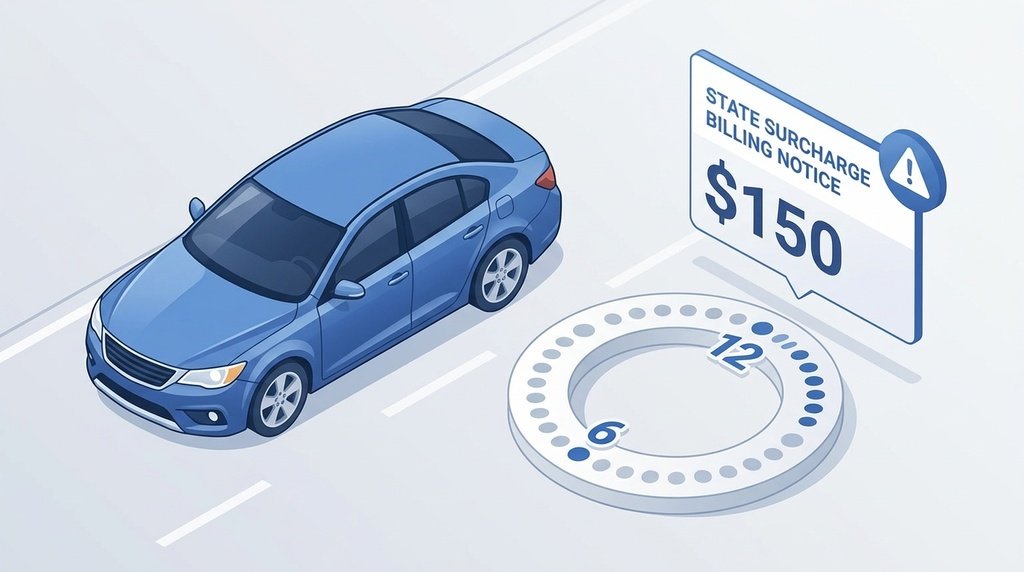
Under New Jersey law, the moment a driver accumulates 6 or more points within a rolling 3-year period, the MVC automatically assesses an annual surcharge.
- The base surcharge fee is $150 for the first 6 points.
- An additional $25 is added for each additional point above 6.
- Crucially, this fee is not a one-time penalty. The MVC bills you this surcharge annually for three consecutive years.
Consider the actual math: if a driver receives a 5-point speeding citation (30+ mph over) and a 2-point careless driving citation, they have 7 points on record. Their annual surcharge is $175 (150base+150 base +150base+25 for the 7th point). Paid across three years, that citation pair costs an extra $525 in direct state surcharges alone—completely separate from the original ticket fines and insurance premium increases.
Failing to pay an MVC surcharge results in an automatic suspension of your New Jersey driver license and a mandatory $100 restoration fee upon settlement.
When Does New Jersey Suspend Your License?
Accumulating too many points directly threatens your legal driving privileges. In New Jersey, point-based suspensions are governed by strict progressive thresholds:
The 12-to-14 Point Warning Notice
When your driving record reaches 12 or more points, the MVC mails a formal Notice of Scheduled Suspension to your home address. The notice outlines the state’s proposed suspension duration, which typically ranges from 30 days to several months depending on your historical record and how quickly the points accumulated.
Upon receiving this notice, motorists generally have three options:
- Accept the Suspension: Surrender your license and refrain from driving for the designated period.
- Request an Administrative Hearing: Contest the suspension terms through a formal written request to the MVC within the deadline specified on the notice.
- Attend the Official Driver Improvement Program (DIP): If eligible, the MVC may allow you to complete an in-person, state-run Driver Improvement Program in lieu of suspension. Completing this program subtracts up to 3 points and places the driver on probationary status for one year.
However, relying on post-suspension relief is risky. The far smarter strategy is proactive point reduction before reaching the 12-point threshold.
How to Remove Points from Your New Jersey Driving Record
New Jersey offers two primary statutory mechanisms to reduce the active points on your driving record:
The 2-Point Defensive Driving Reduction Rule
Under New Jersey statute (N.J.S.A. 17:33B-45.1), drivers can voluntarily complete an approved defensive driving course to remove 2 points from their NJ MVC record.
However, New Jersey enforces strict rules regarding how often this benefit can be applied:
- The 5-Year Frequency Rule: You can only receive a 2-point reduction through a defensive driving course once every 5 years. While you can take the course more frequently for insurance discounts, the MVC will not subtract points if less than five full years have elapsed since your last course-based point reduction.
- Active Points Requirement: You must have active points posted on your record at the time the course completion certificate is processed. The MVC will not create a negative point balance or "bank" points against future citations. If you have 1 point on record and take the course, your balance drops to 0, not -1.
The 1-Year Violation-Free Automatic Deduction
In addition to defensive driving courses, the MVC rewards consistent safe driving. For every one consecutive year (12 months) of driving with zero moving violations and zero suspensions, the MVC automatically subtracts 3 points from your driving record.
The one-year clock begins on the date of your last violation or the date your license was restored following a suspension. Receiving even a 2-point minor ticket resets the 12-month clock to day one.

The 3-Year Insurance Discount: Saving 5% to 10% in New Jersey
Points on your driving record do not just anger the MVC—they trigger substantial increases in your private auto insurance premiums. In New Jersey, insurance carriers operate on their own internal rating systems that review your driving record at every renewal cycle.
Why Insurance Points Differ from MVC Points
Many New Jersey drivers are surprised to learn that their insurance company uses an internal point matrix separate from the state MVC system. While the MVC tracks points for license suspension and state surcharges, insurance companies assess points to calculate risk and set premium rates. A single moving violation can easily raise your annual auto insurance rate by 20% to 30%, adding hundreds of dollars to your policy cost every six months.
State-Mandated Insurance Premium Reductions
Fortunately, New Jersey law provides a powerful financial incentive. When you complete an MVC-approved defensive driving course:
- Every auto insurance carrier licensed in New Jersey is legally required to grant an auto insurance premium discount.
- The discount typically ranges between 5% and 10% applied to liability, collision, and personal injury protection (PIP) coverages.
- The discount remains active on your policy for three consecutive years.
- Unlike the 5-year MVC point reduction limit, you are legally entitled to renew this insurance discount every 3 years simply by retaking an approved course.
For the average New Jersey driver paying $2,000 annually for comprehensive auto coverage, a 10% discount saves $200 per year, or $600 over the three-year certificate term.
How to Complete an MVC-Approved Course Online
Historically, New Jersey drivers had to sacrifice a full Saturday sitting in a crowded municipal classroom to earn point reduction. Today, the entire process can be completed from home.
ETS offers an official New Jersey Defensive Driving Course that is fully licensed and approved by the New Jersey Motor Vehicle Commission.
Key advantages of the online program include:
- 100% Online & Self-Paced: Complete the mandatory 6-hour curriculum on your computer, iPad, or mobile smartphone. You can finish the course in one afternoon or divide your study across several evenings.
- Automatic Progress Saving: Log in and out whenever your schedule allows without losing your place.
- Direct Electronic MVC Submission: Once you complete the straightforward final exam, ETS transmits your completion record electronically to the New Jersey Motor Vehicle Commission to apply your 2-point reduction without requiring in-person office visits.
- Immediate Certificate Delivery: Download your official digital Certificate of Completion instantly to email directly to your auto insurance agent for immediate policy rate discounts.

What Happens to Commercial Drivers (CDL) in New Jersey?
Commercial driver license (CDL) holders face far stricter federal and state standards. Under Federal Motor Carrier Safety Administration (FMCSA) rule 49 CFR § 384.226, states are prohibited from masking, deferring, or dismissing traffic convictions for CDL drivers, regardless of whether the citation occurred in a commercial motor vehicle or a personal passenger car.
While a New Jersey CDL holder can take an approved defensive driving course to earn insurance savings on their personal auto policy, the course cannot mask or remove conviction points from their commercial driving record. Professional drivers must consult legal counsel or their municipal court clerk before attempting to resolve citations through traffic education programs.
Conclusion
The New Jersey point system is designed to penalize moving infractions quickly, and between court fines, steep annual MVC surcharges, and rising insurance premiums, a single traffic ticket can easily cost over $1,000 across three years. By taking advantage of New Jersey's state-approved defensive driving programs, proactive motorists can subtract 2 points from their MVC abstract, avoid the costly 6-point surcharge threshold, and secure a mandatory 5% to 10% insurance rate discount.
ETS offers state-approved online courses across all 50 states – 100% online, self-paced, no timers, with free instant electronic DMV and MVC submission upon completion.
FAQs
How do I check how many points are currently on my New Jersey driving record?
You can view your active point balance by ordering an official Driving History Abstract directly from the New Jersey Motor Vehicle Commission website (njmvc.gov). The abstract shows all historical violations, active point totals, and past point reduction credits.
Can I take a defensive driving course in New Jersey before a ticket posts to my record?
No. The MVC will only reduce points that currently exist on your driving record. If you complete a defensive driving course while having zero points, the 2-point reduction cannot be saved or applied to future tickets. Wait until your citation conviction is processed and points appear before completing the course for point reduction.
How often can I take a New Jersey defensive driving course for insurance discounts?
You can take the course to renew your insurance discount once every 3 years. Most insurance carriers will remove the discount after 36 months unless you submit a newly earned certificate of completion.
Will taking a defensive driving course dismiss my traffic ticket in court?
No. Completing a voluntary defensive driving course does not dismiss a pending citation or eliminate municipal court fines. Instead, it subtracts 2 points from your MVC driving record after the conviction is entered and prevents points from triggering state surcharges.
What happens if I accumulate 6 points in New Jersey within three years?
Accumulating 6 or more points within a rolling 3-year window triggers an annual New Jersey MVC surcharge of $150, plus $25 for each additional point over 6. This surcharge is billed once a year for three consecutive years. Reducing your point total below 6 before the evaluation date protects you from this penalty.


