How to Get a Class A CDL in 2026: The Complete Guide to the FMCSA ELDT Mandate and Online Theory Training

What is Class A ELDT training? Class A ELDT training is the federally mandated Entry-Level Driver Training curriculum required by the Federal Motor Carrier Safety Administration (FMCSA) for all new commercial driver license applicants. Under federal statute 49 CFR Part 380, completing an approved Class A ELDT training course is legally required before any state Department of Motor Vehicles (DMV) is permitted to schedule or administer a commercial road skills exam. By completing certified Class A ELDT training online, aspiring commercial truck drivers satisfy their federal theory requirements at their own pace, get entered into the federal Training Provider Registry (TPR), and take the critical first step toward a high-paying career in the commercial trucking industry.
The February 2022 Federal Shift: What Is the ELDT Mandate?
Prior to February 7, 2022, earning a commercial driver license (CDL) varied wildly from state to state. In some states, a candidate could study a manual, take a basic knowledge quiz, practice in a parking lot with a family friend, and take the road test.
That era is over.
On February 7, 2022, the Federal Motor Carrier Safety Administration (FMCSA) enacted the Entry-Level Driver Training (ELDT) final rule (49 CFR Part 380, Subpart F). This federal mandate established uniform national training standards across all 50 states.
Under the federal mandate, state licensing agencies (whether named the DMV, BMV, MVA, MVC, or SOS) are strictly prohibited from scheduling your commercial road skills exam unless your profile is verified inside the federal Training Provider Registry (TPR). When you arrive at the state testing facility, the examiner queries the Commercial Driver’s License Information System (CDLIS). If your ELDT theory certificate is not registered in the TPR database, the computer blocks the test automatically.
Who Is Required to Complete Class A ELDT?
The federal ELDT mandate applies to any individual pursuing commercial driving credentials in the United States. You must complete an approved ELDT program if you are:
- A First-Time CDL Applicant: Anyone applying for a Class A or Class B Commercial Driver License for the very first time.
- Upgrading a Commercial License: Any current commercial driver upgrading from a Class B to a Class A license (to pull heavier combination trailers).
- Adding Critical Endorsements: Any commercial driver adding a Hazardous Materials (H), Passenger (P), or School Bus (S) endorsement to their license.
Who Is Grandfathered In?
If you earned your Commercial Learner's Permit (CLP) or full CDL prior to February 7, 2022, you are exempt from the initial ELDT training mandate for that specific classification, provided your credential has not lapsed or expired beyond state renewal windows.
Understanding Class A vs. Class B: What Can You Drive?
Before enrolling in training, candidates must understand commercial vehicle weight classifications defined by federal law:
Class A CDL (The Gold Standard of Trucking)
Authorizes the operation of any combination of commercial motor vehicles with a Gross Combination Weight Rating (GCWR) of 26,001 pounds or more, provided the vehicle being towed has a Gross Vehicle Weight Rating (GVWR) exceeding 10,000 pounds.
- Vehicles Covered: Tractor-trailers (semi-trucks), flatbeds, livestock carriers, tanker combinations, and double/triple trailers.
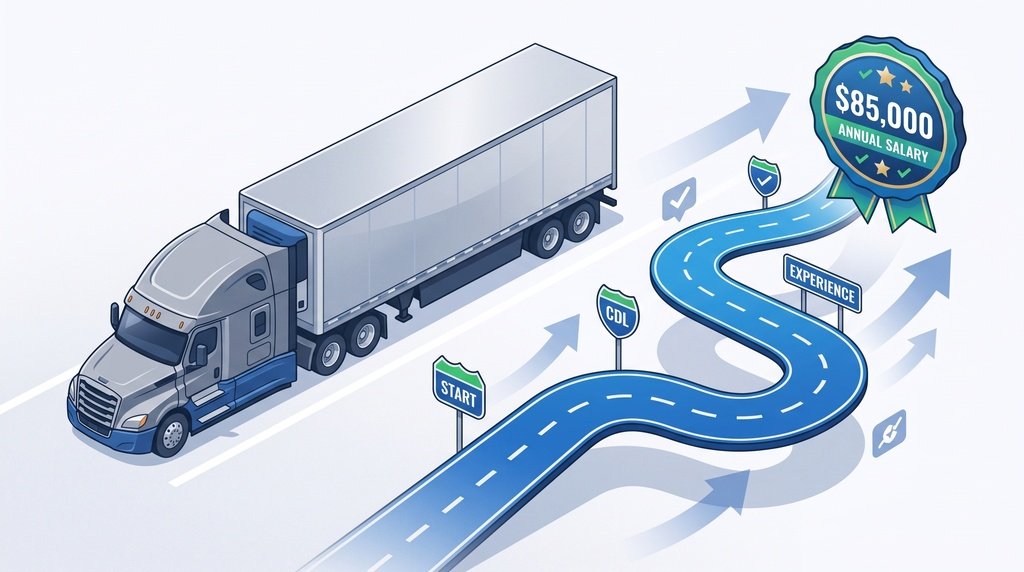
- Career Ceiling: Long-haul regional and Over-the-Road (OTR) freight with starting driver salaries frequently ranging between $70,000 and $100,000+ annually.
Class B CDL (Single-Unit Commercial Vehicles)
Authorizes the operation of any single vehicle with a GVWR of 26,001 pounds or more, or any such vehicle towing a trailer under 10,000 pounds.
- Vehicles Covered: Heavy dump trucks, concrete mixers, city transit buses, large box delivery trucks, and refuse vehicles.
- Career Scope: Primarily local delivery routes with lower freight weight limits.
Because a Class A license permits the holder to operate virtually all Class B and Class C commercial vehicles, it represents the highest-value commercial credential available.
The Two Halves of ELDT: Theory vs. Behind-the-Wheel
A major source of confusion for prospective drivers is how training is delivered. The FMCSA divides ELDT into two mandatory components:
1. Theory Training (Classroom Instruction)
Covers the foundational engineering, federal regulations, and safety protocols behind commercial vehicle operations. Federal law explicitly permits the theory portion to be completed 100% online through an FMCSA-registered training provider.
2. Behind-the-Wheel (BTW) Training
Covers practical vehicle maneuvering on a closed obstacle range (backing, parallel parking, alley docks) and actual supervised driving on public roadways. This portion must be completed in-person in a real commercial motor vehicle with a certified instructor.
The Smart Strategy: Private in-person CDL schools often charge $5,000 to $8,000 for bundled programs that force students to spend weeks sitting in crowded classrooms studying theory. By completing your FMCSA-approved theory online first for just $125, you satisfy the federal classroom mandate at your own pace, get logged in the federal TPR registry, and dramatically reduce the time and tuition required at local driving ranges.
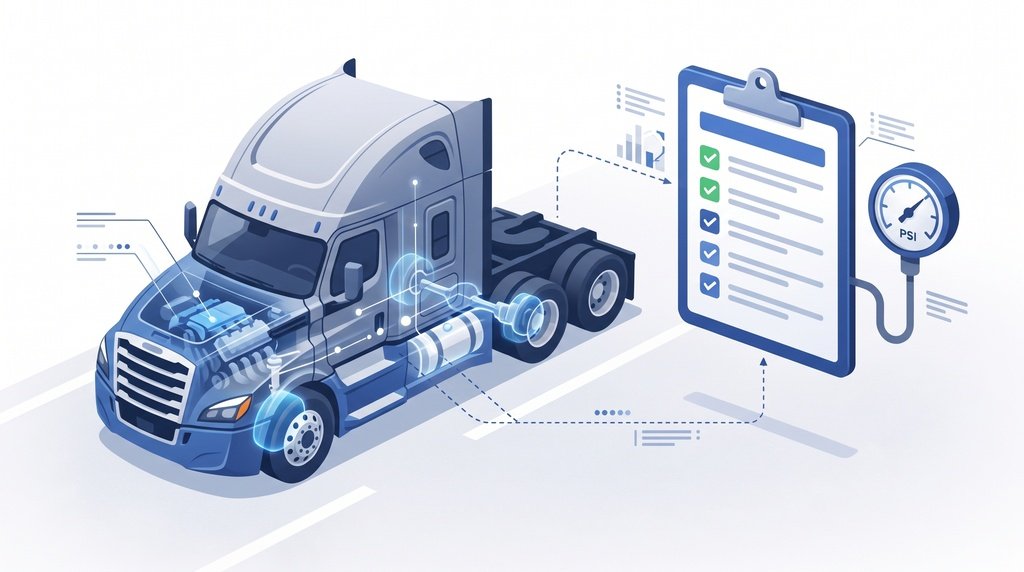
What Does the FMCSA Class A Theory Curriculum Cover?
Federal regulation 49 CFR Part 380, Appendix A mandates comprehensive instruction across more than 30 specialized instructional units organized into five core modules:
Module 1: Basic Vehicle Operation
Orientation to commercial motor vehicles, control interfaces, cockpit dashboard layouts, engine warm-up procedures, advanced manual and automated shifting techniques, backing maneuvers, and tractor-trailer coupling and uncoupling protocols.
Module 2: Safe Operating Procedures
Visual search strategies down the roadway, defensive space cushions around 53-foot trailers, vehicle speed management on curves and downgrades, night driving hazards, and operating heavy combinations across extreme weather (snow, heavy rain, black ice, and mountain passes).
Module 3: Advanced Operating Practices
Hazard perception, managing commercial vehicle blind spots ("No-Zones"), defensive skid control and jackknife recovery techniques, and navigating active railroad highway grade crossings.
Module 4: Vehicle Systems and Maintenance
The engineering mechanics of Air Brake systems (compressors, governors, dual-reservoir air tanks, emergency spring brakes, and ABS), mandatory Daily Vehicle Inspection Reports (DVIR), and identifying out-of-service defects that cause DOT road inspection shutdowns.
Module 5: Non-Driving Activities
Compliance with federal Hours of Service (HOS) regulations under 49 CFR Part 395, operating Electronic Logging Devices (ELD), fatigue countermeasures, driver wellness, post-crash notification protocols, cargo securement calculations, and trip planning.
How to Get Registered in the Federal TPR Registry
The Training Provider Registry (TPR) is the official centralized database managed by the FMCSA. It serves as the digital bridge between approved training schools and state driver licensing agencies.
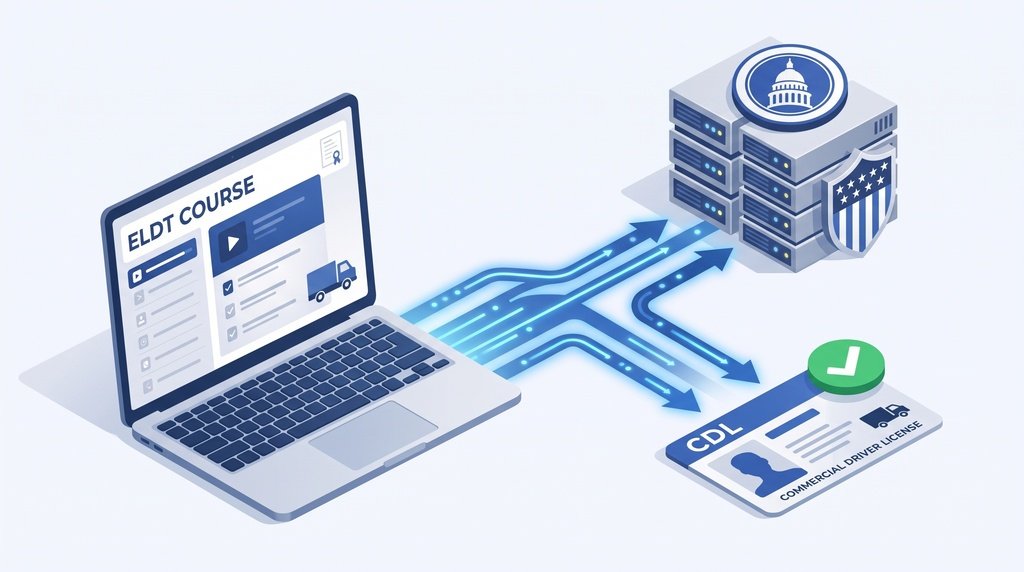
ETS offers the official Class A ELDT Training Online program, fully registered and certified under federal FMCSA standards:
- 100% Self-Paced Learning: Study on your smartphone, tablet, or home computer whenever convenient. Progress saves automatically in real time.
- Instant TPR Transmission: When you finish the course and pass the final review with an 80% score or higher, ETS transmits your completion record directly to the FMCSA Training Provider Registry electronically.
- Zero Paperwork Delays: Within 24 to 48 hours of completion, state DMV computer terminals nationwide recognize your federal clearance, allowing you to schedule your commercial skills driving exam without bureaucratic friction.
Step-by-Step Roadmap: From Zero to Commercial Driver
To earn your Class A CDL efficiently without wasted expenses, follow this proven chronological timeline:
- Obtain a DOT Medical Card: Schedule an examination with an FMCSA-certified medical examiner to secure your Medical Examiner’s Certificate (Form MCSA-5876).
- Study and Pass the Commercial Learner's Permit (CLP) Written Tests: Visit your state licensing office to pass the General Knowledge, Air Brakes, and Combination Vehicles knowledge tests.
- Complete Your Online Class A ELDT Theory Course: Enroll in ETS Traffic School’s online program to master the 30+ federal theory units and get your profile uploaded to the federal TPR registry.
- Complete Behind-the-Wheel Training: Practice range maneuvers (straight-line backing, offset backing, alley dock) and public highway driving with a certified training provider.
- Pass the State CDL Skills Test: Perform the pre-trip vehicle inspection, basic vehicle control skills test, and on-road driving evaluation.
- Receive Your Class A CDL: Collect your official commercial driver license and launch your professional career.
Conclusion
The FMCSA ELDT mandate was created to ensure that every commercial tractor-trailer operator on American interstates commands the highest standard of technical knowledge and defensive road awareness. Meeting this federal requirement does not require spending thousands on rigid classroom lectures. By completing your Class A theory training online through an accredited program, you fulfill federal compliance, secure your entry into the Training Provider Registry, and take command of your path toward a lucrative commercial trucking career.
ETS offers FMCSA-approved online ELDT training nationwide – 100% online, self-paced, no classroom delays, with instant electronic TPR reporting upon completion.
FAQs
Can I take the Class A CDL road test without completing ELDT?
No. Under federal regulation 49 CFR Part 380, state licensing examiners are legally blocked from administering the commercial skills test if the applicant’s record does not show verified completion in the federal Training Provider Registry (TPR).
Is the ELDT theory exam difficult to pass?
FMCSA regulations mandate an 80% passing score on the final theory assessment. Approved online courses provide chapter quizzes and comprehensive practice reviews, and accredited providers allow unlimited test retakes at no extra cost until you pass.
How does the state DMV know I finished my online ELDT course?
Upon passing your final online review, your training provider electronically transmits your certificate details (including your driver license number and state of issuance) directly into the FMCSA Training Provider Registry (TPR). State DMV examiners access this federal portal through the Commercial Driver’s License Information System (CDLIS) when verifying your testing eligibility.
Does this online course cover behind-the-wheel truck driving?
No. Federal regulations divide ELDT into Theory (classroom instruction) and Behind-the-Wheel (range and road driving). This course fulfills the complete federal Theory requirement. In-car vehicle operation and range backing must be completed separately in an actual commercial vehicle with an in-person trainer.
How long does online Class A ELDT theory training take?
Because online courses are self-paced, completion time depends entirely on your schedule. Many motivated students complete the material over a single intensive weekend (15 to 20 study hours), while working individuals spread their study across one to two weeks.


