Got a Traffic Ticket in Oregon? How Court Diversion and Traffic School Dismiss Your Citation

What happens when you get a traffic ticket in Oregon? When you receive a citation in the Beaver State, enrolling in an approved Oregon traffic school program offers a direct legal pathway to have your violation completely dismissed through court diversion. While many drivers search for point removal options, the Oregon traffic school system operates differently: Oregon has no driver point system, meaning citations impact your record directly as convictions. By obtaining court permission and completing an authorized Oregon traffic school course online, eligible drivers keep moving violations off their permanent Oregon DMV record, prevent automatic license suspensions, and stop auto insurance rates from skyrocketing.
The Big Oregon Myth: Does Oregon Have a Driver Point System?
The most common misconception among motorists cited in Oregon—especially drivers who recently relocated from California, Washington, or New Jersey—is asking how many "points" their ticket will add to their license.
The short answer: Oregon does not use a point system.
Oregon Driver and Motor Vehicle Services (ODOT DMV) does not assign two, three, or four points to your record when you are convicted of speeding, careless driving, or failing to yield. Instead, the Oregon DMV operates under a pure conviction-tracking system.
When you pay a traffic citation without contesting it or are found guilty in municipal or justice court, the court clerk notifies the DMV. The violation is entered onto your permanent driving abstract as an official moving violation conviction. Because insurance companies review conviction abstracts—not artificial point values—even a single entry can trigger substantial insurance surcharges for three to five years.
How the Oregon DMV Driver Improvement Program Actually Works
Just because Oregon lacks points does not mean the state ignores repeat offenders. Under Oregon Administrative Rules (OAR 735-064-0220), the DMV monitors moving violation frequency through its strict Driver Improvement Program.
The state tracks your driving history within specific rolling windows:
- The 18-Month Warning Threshold: If you accumulate 2 moving violation convictions within any 18-month window, the Oregon DMV sends an advisory warning letter to your address.
- The Suspension Threshold: If you accumulate 3 moving violation convictions within 18 months (or 4 convictions within 24 months), the Oregon DMV immediately issues a mandatory 30-day driver license suspension.
- Probationary Status: Following reinstatement after a suspension, drivers are placed on strict 12-month probationary status. Any moving violation conviction during this period triggers an immediate 60-day or 90-day suspension.
Because suspension depends strictly on conviction counts, dismissing a single ticket through traffic school diversion can mean the difference between staying legally on the road and losing your driving privileges.

Understanding Oregon Traffic Violations and Fines
Traffic offenses in Oregon are governed by Oregon Revised Statutes (ORS) Chapter 153. Offenses are categorized into four statutory classes, each carrying a standard presumptive fine:
1. Class A Violations
The most serious non-criminal infractions in Oregon, including speeding in excess of 30 mph over the posted speed limit or passing a stopped school bus displaying flashing red lights. Presumptive fine: $440 (can reach up to $2,000 in highway work zones or school zones).
2. Class B Violations
Covers moderate infractions, such as speeding 21 to 30 mph over the limit, careless driving without crash involvement, and driving without a valid license. Presumptive fine: $265.
3. Class C Violations
The most common traffic citations issued by Oregon State Police and county sheriffs, including speeding 11 to 20 mph over the limit, running a red light, and illegal lane changes. Presumptive fine: $165.
4. Class D Violations
Minor infractions, such as speeding 1 to 10 mph over the limit or minor equipment violations. Presumptive fine: $115.
While paying the presumptive fine listed on your citation resolves the court's financial claim, it acts as an automatic admission of guilt. That conviction posts to your record and follows you directly to your next insurance renewal.
What Is Oregon Court Diversion and How Does It Work?
Traffic School Diversion (also called Deferred Disposition) is an administrative option authorized by local municipal and county circuit courts across Oregon. Under diversion, the court agrees to withhold entry of a conviction while you satisfy specific conditions—primarily completing an approved 4-hour defensive driving course.
Once you submit your certificate of completion within the court-mandated deadline, the court formally dismisses the citation.
The Tremendous Advantages of Diversion:
- Zero Conviction on Your DMV Record: The ticket never posts to your public driving abstract.
- Zero Insurance Surcharges: Because no conviction exists, your auto insurance company cannot see the incident or use it to raise your annual premiums.
- No Impact on Your 18-Month Count: The dismissed citation does not count toward the DMV's 3-conviction suspension threshold.
Who Qualifies for Traffic School Diversion in Oregon?
Court diversion is not an automatic right. In Oregon, judicial districts and municipal courts establish local diversion criteria based on guidelines from the Oregon Judicial Department.
To qualify for traffic school diversion, motorists generally must meet the following criteria:
- Valid Non-Commercial License: You must possess an active, non-suspended driver license.
- Clean Recent Record: Most Oregon courts require that you have had no moving violation convictions anywhere in the country within the preceding 12, 24, or 36 months (depending on county rules).
- Eligible Infraction Level: Diversion is typically limited to Class B, C, and D moving violations. Major Class A violations, street racing, reckless driving, or driving under the influence of intoxicants (DUII) are strictly disqualified.
- No Accidents with Serious Injury: Citations arising from motor vehicle crashes resulting in substantial bodily injury or severe property damage are generally barred from administrative diversion.
- Commercial Drivers Prohibited: Federal regulations (49 CFR § 384.226) strictly prohibit courts from masking or deferring citations for Commercial Driver License (CDL) holders, regardless of whether the driver was operating a commercial rig or their personal car.
Step-by-Step: How to Dismiss Your Oregon Ticket Through Traffic School
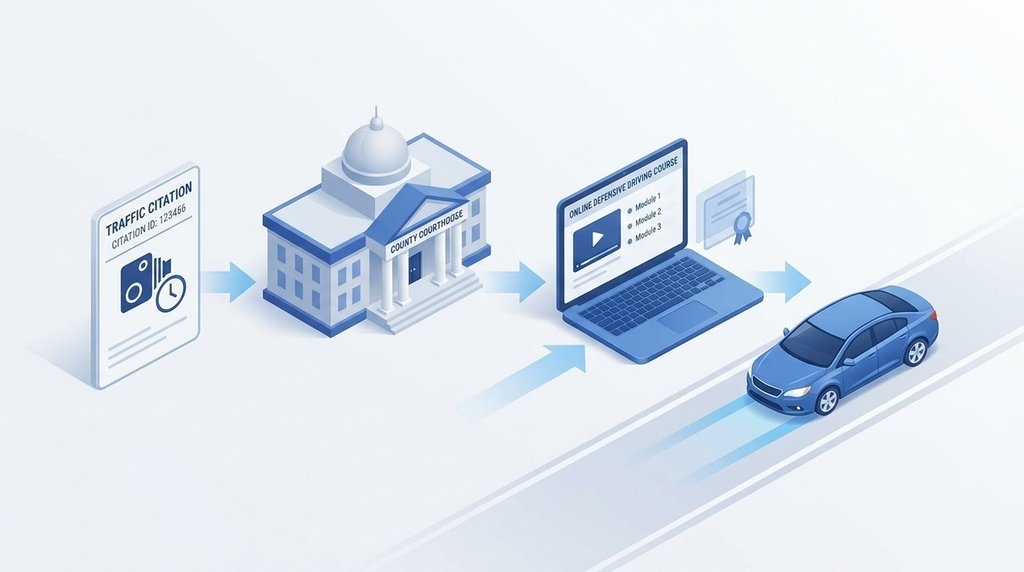
Navigating the Oregon traffic diversion process requires strict adherence to chronological order. Making a misstep can result in a forfeited court fee and an unmasked conviction.
Step 1: Examine Your Citation and Identify Your Court
Look at the bottom of your ticket. It lists the court handling your case—such as Multnomah County Circuit Court in Portland, Washington County Circuit Court in Hillsboro, Clackamas County Circuit Court in Oregon City, or Eugene Municipal Court—along with your required appearance or response date.
Step 2: Contact the Court BEFORE Enrolling in a Course
This is the single biggest mistake Oregon drivers make. Never enroll in a traffic school course before receiving official court permission.
You must contact the court clerk (by phone, mail, online portal, or in person) before the arraignment date listed on your citation. Ask whether your ticket qualifies for the court's Traffic School Diversion program.
Step 3: Enter a Plea and Pay the Court Diversion Fee
If approved, you will be required to enter a plea of guilty or no contest and pay the court’s administrative diversion fee. In many Oregon courts, this administrative fee equals or slightly discounts the original presumptive fine.
Step 4: Complete the Approved 4-Hour Course Online
Once the court grants diversion permission, you are assigned a completion deadline (typically 30 to 90 days).
ETS offers an official Oregon Traffic School Course Online that satisfies municipal and circuit court diversion requirements across the state:
- State-Standard 4-Hour Format: Covers Oregon vehicle codes, rural and highway defensive driving, bad weather navigation, and collision avoidance techniques.
- 100% Online & Self-Paced: Complete the modules on your computer, tablet, or smartphone at home. Progress is saved automatically, allowing you to study at your own pace without rigid timers.
- Straightforward Final Review: A 20-question multiple-choice exam with an instant 70% passing threshold and free review retakes.
- Instant Digital Certificate: Download your official Certificate of Completion the moment you pass.
Step 5: Deliver Proof of Completion to the Court
Unlike California, where schools submit records electronically into a centralized DMV database, Oregon courts require the driver to provide proof of completion directly to the court clerk.
Email your digital PDF certificate, submit it via the court's online document portal, or deliver a physical copy to the court clerk's office before your assigned due date. Once verified, the judge formally enters an order of dismissal, and your driving record remains completely clean.
The Financial Return: Why Oregon Diversion Saves Hundreds
Some motorists hesitate to apply for diversion because courts still require an administrative fee roughly equivalent to the original ticket cost. However, looking at the immediate ticket fine misses the real financial reality:
- A single speeding conviction on an Oregon driving abstract raises private auto insurance rates by an average of 18% to 28%.
- On a standard $1,600 annual policy, that increase costs approximately $300 to $450 extra every year.
- Because insurance underwriting penalties remain active for 36 to 60 consecutive months, an unmasked conviction costs between $900 and $2,200 in cumulative insurance increases.
Paying the court fee and completing a $39.95 online course eliminates that entire multi-year financial penalty, preserving your budget and protecting your clean driving record.

Conclusion
A traffic ticket along I-5, I-84, or Highway 26 does not have to damage your driving record or inflate your auto insurance premiums for years to come. While Oregon does not have a point system, moving violation convictions accumulate quickly toward state suspension thresholds. By acting before your court appearance deadline, requesting Traffic School Diversion, and finishing an approved 4-hour online course, you can secure a complete court dismissal and keep your driving abstract spotless.
ETS offers court-accepted online courses across all 50 states – 100% online, self-paced, no timers, with same-day digital certificate delivery upon completion.
FAQs
Does Oregon have a point system for speeding tickets?
No. Oregon does not use a driver point system. Instead, the Oregon DMV tracks moving violations by counting convictions. Accumulating 3 convictions within 18 months results in an automatic 30-day driver license suspension under OAR 735-064-0220.
Can I take an Oregon traffic school course before contacting the court?
No. You must request and receive official permission for Traffic School Diversion from the court clerk or judge before you complete the course. Taking a course independently without court authorization will not dismiss your citation or waive your fine.
How long does an Oregon online traffic school course take?
The standard Oregon court-accepted defensive driving course covers 4 hours of curriculum. Online self-paced programs allow you to log in and out whenever convenient, finishing the material in one sitting or over several days.
Will my ticket be dismissed immediately after I finish the course?
Your ticket is dismissed after you deliver your official Certificate of Completion to the court clerk and the court reviews it before your assigned deadline. Once processed, the judge signs an order of dismissal and closes the case without reporting a conviction to the Oregon DMV.
Can out-of-state drivers cited in Oregon attend online traffic school?
Yes. Non-resident motorists cited in Oregon can request diversion through the issuing Oregon court. Completing an approved online course dismisses the Oregon charge, preventing the conviction from being reported back to their home state’s licensing agency through the Interstate Driver License Compact.


