North Carolina Defensive Driving (4-Hour & 8-Hour Online): How to Beat the SDIP Insurance Trap, Improper Equipment & PJC Rules

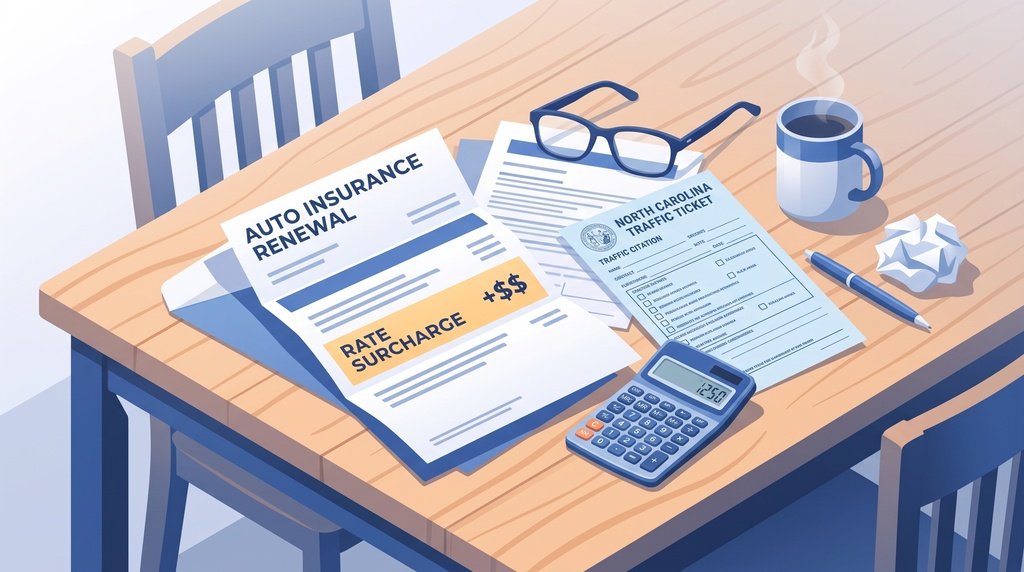
Paying a North Carolina speeding ticket online is one of the most expensive mistakes a driver can make. Most states hand out a minor fine and let insurers decide how much to raise your bill. North Carolina does not work that way. Under state law (NCGS § 58-36-65), a conviction triggers mandatory percentage hikes on your auto policy through the Safe Driver Incentive Plan (SDIP). Even a low-level speeding ticket can jump your insurance rates by 30% to 40% for three straight policy years, while a faster highway ticket triggers a 90% surcharge that nearly doubles what your household pays.
That financial shock is the exact reason local drivers rarely just mail in a check. Instead, they head into District Court looking for a charge reduction to Improper Equipment (0 points) or a Prayer for Judgment Continued (PJC), and prosecutors frequently ask for a completed defensive driving certificate to seal the deal. ETS Traffic School offers both state-aligned lengths 100% online: the North Carolina 4-Hour Defensive Driving Course ($29.00 flat) and the North Carolina 8-Hour Defensive Driving Course ($59.00, down from $74.00).
North Carolina Course Comparison Overview
- 4-Hour Online Course: Flat $29.00 tuition; standard length for Wake County, Guilford County, voluntary NC DMV 3-point removal, and safe-driver insurance refreshers at https://etstrafficschool.com/nc-defensive-driving-4h-course.
- 8-Hour Online Course: Flat $59.00 tuition (regularly $74.00); built for North Carolina county courts outside Wake and Guilford, higher-speed plea deals, and strict court-ordered mandates at https://etstrafficschool.com/nc-defensive-driving-8h-course.
- DMV Point Deduction: Finishing an NC DMV-approved defensive driving clinic removes up to 3 DMV license points from your driving record once every 5 years under NCGS § 20-16.
- Format & Deadlines: 100% online on iPhone, Android, tablet, or computer with automatic timer saving across your 30-day, 60-day, or 90-day court window.
- Certificate Delivery: Downloadable digital certificate plus free U.S. Mail delivery so you can hand the physical original directly to your prosecutor, judge, or insurance agent.
Two Separate Scoreboards: NC DMV License Points vs. The Brutal SDIP Insurance System
Out-of-state traffic advice will mislead you in North Carolina. In California, the California DMV lets you mask a 1-point ticket confidentially once every 18 months so your insurer never sees it. In Texas, a 6-hour Texas TDLR course dismisses eligible speeding tickets outright, and Florida runs a simple 4-hour election track. North Carolina splits every moving conviction onto two completely independent scoreboards at the same time.
Scoreboard number one is NC DMV Driver License Points (NCGS § 20-16). Those points only control whether you keep your physical plastic license. Hit 7 DMV points and the state can assign you to a driver improvement clinic to shave 3 points off your total. Hit 12 DMV points within 3 years (or 8 points within 3 years after a prior reinstatement) and the NC DMV suspends your license for 60 days on a first offense, 6 months on a second, and 12 months on a third.
Scoreboard number two is the Safe Driver Incentive Plan (SDIP) under NCGS § 58-36-65, and this is the scoreboard that empties bank accounts. Unlike other states where insurance hikes are guesswork, the North Carolina Department of Insurance sets hard statutory surcharge percentages that every auto carrier in the state must enforce for three full policy years. For years, drivers dreaded the old 30%, 45%, and 80% tiers; under North Carolina's updated SDIP schedule, those penalties climbed even steeper for 1-point and 2-point convictions while 4-point violations hit a brutal 90% rate jump.
| SDIP Insurance Points | Common North Carolina Trigger Convictions | Mandatory 3-Year Rate Surcharge | Real Impact on a $2,000/yr Policy |
|---|---|---|---|
| 1 SDIP Point | Speeding 10 mph or less over in a zone under 55 mph; routine moving violations | +40% (previously +30%) | Adds $2,400 extra over 3 years. |
| 2 SDIP Points | Speeding over 10 mph above limit (total speed 56 to 75 mph); tailgating; illegal passing | +55% (previously +45%) | Adds $3,300 extra over 3 years. |
| 4 SDIP Points | Reckless driving; passing a stopped school bus; speeding over 75 mph (in under-70 zones) or over 80 mph (in 70+ zones) | +90% (nearly doubles bill) | Adds $5,400 extra over 3 years. |
| 8 SDIP Points | Aggressive driving; driving while license revoked (DWLR) | +200% (triples policy cost) | Adds $12,000 extra over 3 years. |
Here is the catch that blindsides thousands of North Carolina motorists every year. Taking defensive driving after you already paid your fine removes up to 3 DMV points, which helps keep your license from getting suspended, yet removing DMV points does zero to erase SDIP insurance points. Once a speeding conviction posts to your record, the 3-year insurance surcharge is locked in.
According to official North Carolina Department of Insurance Safe Driver Incentive Plan rules under NCGS § 58-36-65, "Insurance points are assigned for convictions of moving traffic violations and at-fault accidents during the three-year experience period, and completing a driver improvement clinic for DMV license point reduction does not remove insurance points assessed under the SDIP."
The Courtroom Escape Hatches: "Improper Equipment" vs. Prayer for Judgment Continued (PJC)
Because paying a ticket online guarantees an SDIP hit, almost every traffic defense strategy in North Carolina revolves around preventing a moving conviction from hitting your record in the first place. When you (or your traffic lawyer) walk into District Court in Charlotte, Raleigh, Greensboro, Durham, Winston-Salem, or Fayetteville, two specific outcomes dominate the docket.
Option 1: Reduction to "Improper Equipment" (NCGS § 20-123.2 & § 20-141(o))
You do not actually need a broken speedometer to get an Improper Equipment plea. Under NCGS § 20-141(o), North Carolina lawmakers designated "Improper Equipment - Speedometer" (NCGS § 20-123.2) as a statutory lesser offense for speeding tickets (capped at 25 mph over the limit). In plain English, the Assistant District Attorney agrees to downgrade your speeding citation into a non-moving equipment infraction.
Why do drivers chase this plea so hard? Because an Improper Equipment conviction carries 0 NC DMV points and 0 SDIP insurance points. You pay court costs plus a mandatory $50 statutory surcharge (roughly $263 to $266 total in counties like Wake), and your auto insurance bill stays completely untouched. In busy districts like Mecklenburg County, Union County, and Wake County, prosecutors routinely require a completed 4-hour or 8-hour defensive driving certificate before signing off on an Improper Equipment deal, especially if your speed was 15+ mph over the limit or you had another ticket in the last three years.
Option 2: Prayer for Judgment Continued (PJC) and Its Hidden Family Trap
A PJC is a uniquely North Carolina judicial ruling where you plead guilty to the ticket, yet the judge withholds final judgment and enters no punishment. Done right, a PJC blocks both DMV points and SDIP insurance points.
Still, never burn a PJC casually on a small ticket, because North Carolina hides four nasty traps inside the PJC rules:
- The Household Insurance Cap: Under SDIP rules, insurers only recognize one PJC per household every 3 years (and NC DMV caps you at two PJCs per person every 5 years). If you use a PJC on a minor ticket this spring and your spouse or teenager needs a PJC next fall on the same auto policy, both convictions suddenly trigger SDIP points at the exact same time.
- The 25+ MPH Statutory Ban: By law, a judge cannot grant a PJC or an Improper Equipment reduction if you were cited for speeding more than 25 mph over the posted speed limit.
- Zero PJCs for School Bus or DWI Charges: Passing a stopped school bus, impaired driving (DWI), and driving while revoked never qualify for a PJC.
- Strict CDL Holder Exclusion (49 CFR § 384.226): If you hold a Commercial Driver's License (CDL) or got pulled over in a commercial truck, both North Carolina law and federal anti-masking rule 49 CFR § 384.226 treat a PJC as a full conviction and block ticket dismissal in North Carolina, California, Texas, and Florida, even when you were driving your personal sedan off duty.
As veteran Wake and Mecklenburg County traffic defense attorneys tell clients before court dates, "Save your household PJC for a genuine emergency, bring a completed four-hour or eight-hour defensive driving certificate to the District Attorney, and push for an Improper Equipment reduction first so your spouse and kids still have a safety net."

Which Length Do You Need: 4-Hour Course or 8-Hour Course?
North Carolina does not use one single course length across all 100 counties. Picking the wrong duration before your court date wastes time and forces you to re-enroll, so check your ticket county and your goal before clicking start:
- Enroll in the North Carolina 4-Hour Defensive Driving Course ($29.00) if: Your citation was issued in Wake County (Raleigh, Cary, Apex) or Guilford County (Greensboro, High Point), your judge specifically authorized a 4-hour program, you are taking a voluntary class to remove 3 NC DMV points (once every 5 years), or you want a safe-driver refresher for an insurance carrier check.
- Enroll in the North Carolina 8-Hour Defensive Driving Course ($59.00) if: Your citation was issued in a North Carolina county outside Wake and Guilford (including Mecklenburg, Forsyth, Cumberland, Buncombe, Durham, or New Hanover where 8-hour pleas are standard), your speed exceeded 15+ mph over the posted limit, or your District Court judge specifically ordered an 8-hour driver improvement clinic.
Inside the Online Curriculum: Built for I-40, I-85, I-485 & Mountain Grades
Nobody wants to lose an entire Saturday sitting in a community college classroom. Both our 4-Hour Course and 8-Hour Course run 100% online on any screen and save your exact minute mark automatically across logins:
- Chapter 1 - North Carolina DMV Points, SDIP Math & Court Options: How 12 DMV points in 3 years triggers suspension, why 1 to 4 SDIP points hike rates by 40% to 90%, and how Improper Equipment and PJC dispositions actually protect your driving record.
- Chapter 2 - Space Cushions on I-40, I-85, I-95 & Charlotte's I-485 Loop: Maintaining safe following distances in Triangle and Charlotte commuter traffic, surviving sudden weave-lane merges, and staying clear of tractor-trailer blind spots.
- Chapter 3 - Speed Physics, Stopping Distances & Blue Ridge Mountain Grades: Why climbing from 60 mph to 80 mph on I-26 or western I-40 spikes crash energy dramatically, preventing brake fade on long mountain descents, and handling ABS threshold stops.
- Chapter 4 - North Carolina Texting Laws (NCGS § 20-137.4A) & Distraction: State bans on texting or reading email while driving, strict zero-phone rules for drivers under age 18, and breaking visual-manual distraction habits.
- Chapter 5 - North Carolina's Move Over Law (NCGS § 20-157) & Work Zones: Legal lane-change and speed-drop requirements for troopers, NCDOT IMAP trucks, tow operators, and utility vehicles, plus heavy $250 work-zone penalties.
- Chapter 6 - Hurricane Downpours, Coastal Flooding & Piedmont Black Ice: Preventing hydroplaning on pooled interstate ruts, turning around at flooded low-water crossings, and recovering smoothly from winter ice skids.
- Chapter 7 - Sharing the Road With Pedestrians, Cyclists & School Buses: North Carolina's harsh 5-DMV-point / 4-SDIP-point penalties for passing a stopped school bus, safe passing clearances for cyclists, and right-of-way at roundabouts.
- Chapter 8 - Impaired Driving (0.08% BAC), Fatigue & Final Exam: Understanding North Carolina's zero-tolerance laws for under-21 drivers, 12-point (340% surcharge) DWI consequences, and passing the 25-question multiple-choice final exam (requiring 80% to pass after short 10-question chapter checks).

Price Breakdown: Flat Online Tuition With Zero Hidden Checkout Fees
ETS Traffic School lists one straightforward flat price for each North Carolina course. Enrollment, coursework, chapter quizzes, the final exam, and certificate delivery are all included without hidden certificate surcharges.
| Course / Fee Item | 4-Hour NC Course | 8-Hour NC Course | Notes |
|---|---|---|---|
| ETS Traffic School Flat Tuition | $29.00 (Enroll Here) | $59.00 (was $74.00) (Enroll Here) | One-time payment; zero hidden add-ons. |
| 100% Online Mobile & Desktop Access | $0.00 (Included) | $0.00 (Included) | Pause and resume anytime across devices. |
| Chapter Quizzes & 25-Question Final Exam | $0.00 (Included) | $0.00 (Included) | 80% passing score on multiple-choice test. |
| Certificate of Completion (Digital + Free U.S. Mail) | $0.00 (Included) | $0.00 (Included) | Expedited shipping available if your court date is close. |
| NC District Court Costs / Improper Equipment Fee | Varies (~$263+ total) | Varies (~$263+ total) | Paid directly to the Clerk of Superior Court. |
5 Steps to Complete Your North Carolina Course and Protect Your Rate
Following these steps in order keeps your paperwork clean and prevents an accidental guilty plea:
- Step 1 - Confirm Your Required Length Before Court: Check the county on your citation and ask your District Attorney's office, traffic attorney, or court clerk whether your Improper Equipment or ticket dismissal agreement requires the 4-hour course (standard in Wake and Guilford) or the 8-hour course (required in most other counties).
- Step 2 - Register Online in 2 Minutes: Enroll in the 4-Hour NC Defensive Driving Course or the 8-Hour NC Defensive Driving Course using your legal name, North Carolina driver's license details, and citation info.
- Step 3 - Complete the Chapters at Your Own Pace: Study on your smartphone during lunch or on your laptop at night; every completed minute and chapter quiz saves automatically.
- Step 4 - Pass the 25-Question Final Exam: Score 80% or higher on the multiple-choice final test to unlock your official Defensive Driving Certificate of Completion.
- Step 5 - Submit Your Certificate Yourself Before Your Deadline: ETS Traffic School delivers the certificate directly to you rather than filing on your behalf, so bring your printed original to your court date (or email it to your traffic lawyer), submit it to the NC DMV for your 3-point license deduction, or send a copy to your auto insurer before your 30-day, 60-day, or 90-day deadline closes.
Frequently Asked Questions (FAQ)
If I already paid my North Carolina ticket online, will this course remove my SDIP insurance surcharge?
No. Under North Carolina law (NCGS § 58-36-65), paying a speeding ticket online enters a conviction that locks in SDIP insurance points for three policy years; completing a defensive driving course afterward can remove up to 3 DMV license points (once every 5 years) to protect you from suspension, yet it cannot erase SDIP points after conviction.
How can I tell if I need the 4-hour or 8-hour North Carolina course?
Check the county printed at the top of your citation. Wake County and Guilford County typically use the 4-hour course, whereas most other North Carolina counties and higher-speed plea deals require the 8-hour course; always verify with the court clerk or your attorney before paying.
What happens if two people in my house use a PJC within 3 years?
Both tickets hit your insurance bill. North Carolina insurers only honor one PJC per household every 3 years; if a second licensed driver on your policy takes a PJC inside that same 3-year window, the insurance company legally voids both PJCs and charges SDIP points for both moving violations.
How often can I use defensive driving to remove 3 NC DMV points?
Once every 5 years. Under NCGS § 20-16, the North Carolina Division of Motor Vehicles allows eligible drivers to deduct 3 license points by completing an approved driver improvement clinic once in any five-year period.
Statutory Sources & Editorial Verification (E-E-A-T)
This guide was researched and verified against active North Carolina General Statutes, North Carolina Department of Insurance SDIP tables, and federal motor carrier regulations (current as of November 2026):
- North Carolina General Statutes (NCGS) § 58-36-65 (Safe Driver Incentive Plan - SDIP): Statutory authority governing North Carolina's mandatory 3-year insurance point surcharges (currently 40% for 1 point, 55% for 2 points, 70% for 3 points, 90% for 4 points, 200% for 8 points, and 340% for 12 points) and the 1-per-household-in-3-years PJC insurance rule.
- North Carolina General Statutes (NCGS) § 20-16 (Driver License Points & Driver Improvement Clinic): Official NC DMV rules establishing the 12-point-in-3-years license suspension threshold (60-day first suspension) and the 3-point clinic deduction available once every 5 years (distinct from point-masking systems run by the California DMV or Texas TDLR).
- North Carolina General Statutes (NCGS) § 20-123.2, § 20-141(o) & § 7A-304(a)(4b): Statutory framework allowing District Attorneys across North Carolina county courts to reduce qualifying speeding tickets (25 mph or less over the limit) to zero-point "Improper Equipment - Speedometer" with a $50 state surcharge.
- North Carolina General Statutes (NCGS) § 20-137.4A, § 20-157 & 49 CFR § 384.226: State texting and Move Over laws alongside federal FMCSA anti-masking provisions barring PJC or ticket dismissal masking for Commercial Driver's License (CDL) holders across North Carolina, California, Texas, and Florida.


