Class B ELDT Training Online: The Complete Guide to FMCSA Theory Requirements and TPR Submission

What is Class B ELDT training online? Class B ELDT training online is a federally mandated Entry-Level Driver Training theory curriculum required by the Federal Motor Carrier Safety Administration (FMCSA) for all first-time Commercial Driver's License (CDL) applicants seeking a Class B license or upgrading from a Class C commercial credential. Enrolling in an authorized Class B ELDT training online course fulfills the mandatory federal classroom topics under 49 CFR Part 380, Appendix C, electronically registers your graduation in the national Training Provider Registry (TPR), and unlocks your eligibility to schedule the CDL road skills test at your state licensing agency.
Prior to February 2022, aspiring commercial drivers could study state CDL manuals independently and schedule their practical driving exams directly. Under current federal law, state Department of Motor Vehicles (DMV) or Department of Public Safety (DPS) testing examiners are legally prohibited from administering a commercial road skills exam until your verified ELDT theory record appears in the FMCSA Training Provider Registry.
Understanding how Class B ELDT theory training works, the types of commercial vehicles it qualifies you to operate, and how to complete your certification online for just $34.95 gives you the fastest, most cost-effective path into the commercial driving industry.
What Is the Federal FMCSA ELDT Mandate?
The Entry-Level Driver Training (ELDT) mandate is a unified federal safety standard established by the Federal Motor Carrier Safety Administration under 49 CFR Part 380. Fully implemented on February 7, 2022, the rule replaced the patchwork of individual state training laws with a single federal baseline.
The ELDT rule applies nationwide to:
- Any driver applying for a first-time Class A or Class B CDL.
- Any commercial driver upgrading an existing Class C CDL to a Class B or Class A.
- Any commercial driver adding a Passenger (P), School Bus (S), or Hazardous Materials (H) endorsement for the first time.
Under the federal framework, entry-level driver training is divided into two distinct components: Theory (Classroom Knowledge) and Behind-The-Wheel (BTW Range and Public Road Skills). While behind-the-wheel instruction requires practical in-person vehicle operation, the FMCSA explicitly permits students to complete the entire ELDT theory requirement through certified online distance-learning programs.
The Role of the Training Provider Registry (TPR)
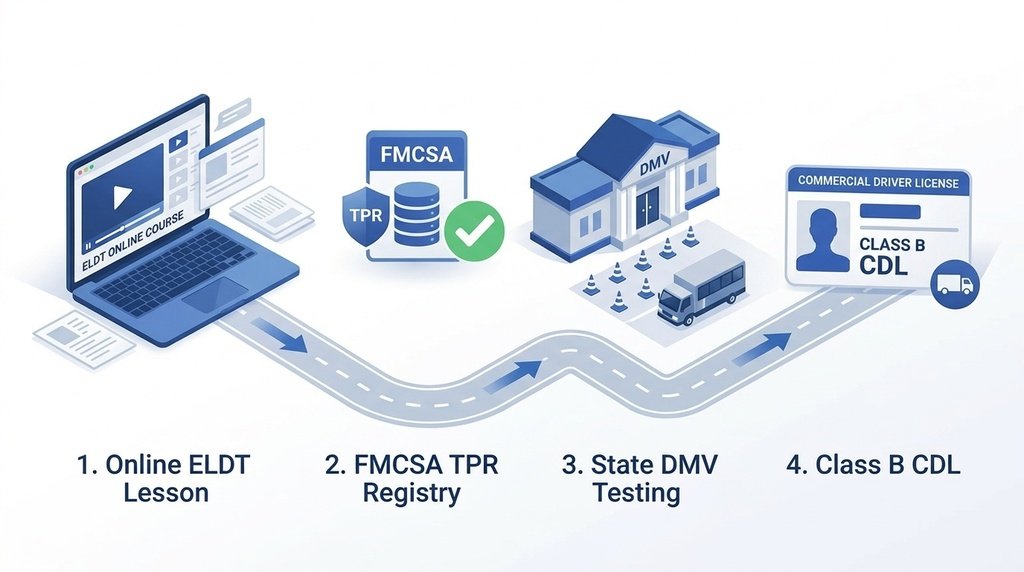
The FMCSA Training Provider Registry is the central federal database that bridges commercial driving schools and state licensing authorities. When you complete an approved online theory program, your training provider transmits your completion record—including your name, date of birth, driver's license number, and exam score—directly to the TPR.
When you arrive at your state DMV testing center for your pre-trip inspection, basic controls, and road driving test, the state examiner verifies your TPR profile before issuing your test slot. Without a verified record in the TPR, state examiners cannot administer your skills exam.
Class B vs. Class A CDL: Which Commercial License Fits Your Career?
Choosing between a Class A and a Class B commercial driver's license is one of the most critical decisions new commercial drivers make. The two license classes govern different vehicle weights, equipment configurations, and career lifestyles.
Under federal definition (49 CFR § 383.91):
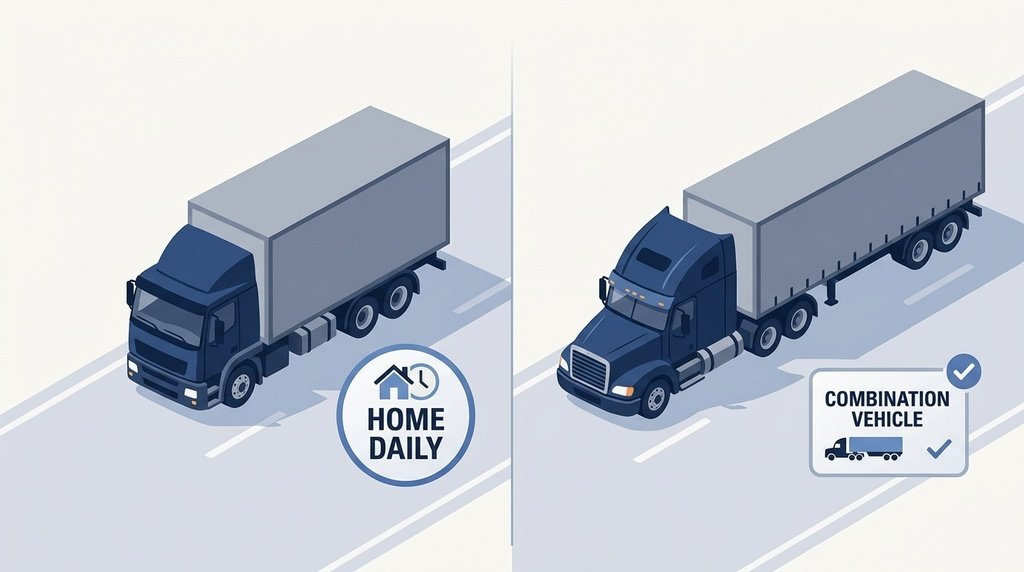
- Class A CDL: Authorizes the operation of any combination of vehicles with a Gross Combination Weight Rating (GCWR) of 26,001 pounds or more, provided the Gross Vehicle Weight Rating (GVWR) of the towed vehicle or trailer exceeds 10,000 pounds. This covers tractor-trailers, semi-trucks, flatbeds, and livestock carriers.
- Class B CDL: Authorizes the operation of any single vehicle with a GVWR of 26,001 pounds or more, or any such vehicle towing a trailer that does not exceed 10,000 pounds GVWR.
| Feature | Class B CDL | Class A CDL |
|---|---|---|
| Primary Vehicle Types | Straight trucks, box trucks, dump trucks, cement mixers, motor coaches, school buses | Tractor-trailers, semi-trucks, double/triple trailers, car haulers, tankers |
| Towed Unit Limit | Trailer must weigh 10,000 lbs or less | Trailer can weigh over 10,000 lbs |
| Typical Route Type | Local and regional (home daily) | Over-The-Road (OTR), regional, and local |
| Coupling / 5th Wheel | Not required for standard operations | Mandatory mastery of kingpins and 5th wheels |
| Training Duration | Shorter theory curriculum; faster testing path | Extended combination-vehicle curriculum |
| Average Starting Cost | Lower barrier to entry ($34.95 online theory) | Higher initial school investment |
The "Home Daily" Advantage of Class B Driving
While Class A drivers frequently run Over-the-Road (OTR) routes that keep them away from home for weeks at a time, Class B positions are predominantly local and regional.
Class B drivers operate within city limits and regional trade corridors, handling municipal infrastructure, commercial concrete delivery, local parcel freight, waste management, and passenger transit. For drivers seeking a steady commercial driving income without sacrificing family life, Class B offers the ideal balance: competitive pay with daily home time.
What Vehicles Can You Drive with a Class B CDL?
A Class B commercial license qualifies you to operate an extensive variety of single-unit heavy vehicles across construction, logistics, public transit, and municipal services:
- Heavy Straight Trucks & Box Trucks: Large commercial delivery vehicles utilized by logistics carriers (FedEx Freight, UPS, Amazon Freight Partners, regional distribution centers) for heavy freight distribution.
- Construction & Aggregate Vehicles: Dump trucks, ready-mix concrete mixers, roll-off trucks, and asphalt haulers operating on construction and civil infrastructure jobs.
- Public Transit & Motor Coaches: City transit buses, commuter shuttles, airport motor coaches, and interstate charter tour buses (requires Passenger [P] endorsement).
- School Buses: Public and private school transportation vehicles (requires Passenger [P] and School Bus [S] endorsements).
- Municipal & Utility Trucks: Solid waste sanitation trucks, vacuum sewer trucks, bucket utility trucks, snowplows, and street sweepers.
- Fuel & Liquid Delivery Trucks: Local propane, home heating oil, and municipal water tank trucks with capacities under combination-weight limits (requires Tanker [N] or Hazmat [H] endorsements).
Class B ELDT Theory Curriculum: The 5 Core FMCSA Modules
Under 49 CFR Part 380 Appendix C, the federal government mandates that every approved Class B ELDT theory course cover all essential commercial vehicle operating competencies. The ETS curriculum delivers complete coverage across the 5 required instructional units:
1. Basic Vehicle Operation & Control
Mastering the mechanical fundamentals of operating heavy single-unit vehicles:
- Cockpit orientation, gauge monitoring, and control mechanisms.
- Progressive manual and automatic transmission shifting strategies.
- Proper backing maneuvers, straight-line alley docks, and parallel parking.
- Spatial positioning, turn apex navigation, and tail-swing clearance.
2. Safe Operating Procedures & Advanced Practices
Developing situational defensive habits on busy highways and urban corridors:
- Systematic visual search patterns and blind spot management.
- Speed control on highway downgrades, bridge clearances, and exit ramps.
- Space cushion management in urban stop-and-go traffic.
- Recognizing road friction changes, hydroplaning risks, and severe weather protocols.
3. Advanced Operations & Emergency Maneuvers
Reacting decisively to critical in-transit emergencies:
- Skid recognition and front-wheel vs. drive-wheel skid recovery.
- Off-road vehicle recovery and emergency roadside pull-offs.
- Brake fade mitigation on steep mountain descents.
- Equipment fire prevention, fire extinguisher deployment, and hazardous cargo identification.
4. Vehicle Systems & Air Brake Fundamentals
Gaining in-depth mechanical comprehension of commercial vehicle sub-systems:
- Complete operational dynamics of dual-circuit air brake systems.
- Air compressors, governors, storage reservoirs, and moisture ejectors.
- Low air pressure warning systems, spring brakes, and tractor-protection valves.
- Suspension systems, steering components, and drive axle weight distribution.
5. Non-Driving Activities: HOS, ELDs, and Inspections
Understanding the federal regulatory framework governing commercial operators:
- Federal Hours of Service (HOS) rules under 49 CFR Part 395 (11-hour driving rule, 14-hour on-duty window, mandatory 30-minute breaks, and 60/70-hour weekly limits).
- Operation and compliance with Electronic Logging Devices (ELDs).
- Systematic Pre-Trip, En-Route, and Post-Trip vehicle inspections to prevent DOT out-of-service orders.
- Federal medical qualifications, drug and alcohol testing mandates, and whistleblower protections under Surface Transportation Assistance Act regulations.
Step-by-Step Pathway: How to Get Your Class B CDL
Earning your Class B CDL follows a clear five-step regulatory progression:
Step 1: Obtain Your DOT Medical Examiner's Certificate (Form MCSA-5876)
Before taking commercial driving exams, you must pass a Department of Transportation physical examination administered by a certified medical examiner listed on the FMCSA National Registry. Once passed, you receive a valid DOT Medical Card.
Step 2: Pass General Knowledge & Air Brakes Exams for Your CLP
Visit your local state licensing office to pass the written commercial knowledge tests:
- General Knowledge Exam: Core commercial vehicle rules and safety.
- Air Brakes Exam: Pneumatic brake systems (essential to avoid an "L" air brake restriction on your license). Upon passing, the state issues your Commercial Learner's Permit (CLP), valid for 180 days.
Step 3: Complete Class B ELDT Theory Online with ETS
Enroll in the approved online Class B ELDT program. Study at your own pace from your phone, tablet, or home computer. As soon as you pass the comprehensive end-of-course review with an 80% score, ETS transmits your graduation record directly to the FMCSA Training Provider Registry.
Step 4: Complete Practical Behind-The-Wheel (BTW) Training
Federal law requires in-person vehicle practice covering vehicle inspection, basic control skills (backing and maneuvering on a closed range), and public road driving. You can complete this through a local employer, municipal fleet training department, or commercial driving school.
Step 5: Pass the State CDL Skills Exam and Receive Your License
With your theory and BTW records logged in the FMCSA TPR, schedule your practical exam with your state DMV or authorized third-party tester. The test consists of:
- Pre-Trip Vehicle Inspection: Demonstrating thorough mechanical safety knowledge.
- Basic Vehicle Control Skills: Straight-line backing, offset backing, and parallel parking.
- On-Road Driving Test: Safely operating the vehicle in mixed traffic. Pass all three sections, and your state issues your official Class B Commercial Driver's License.
Why Choose ETS Traffic School for Your Class B ELDT Theory?
Traditional commercial driving academies often bundle ELDT theory into expensive in-person packages ranging from $300 to over $1,000, forcing students to take unpaid time off work to sit in scheduled lectures.
ETS provides a modern, fully compliant alternative designed around your busy schedule:
- Official FMCSA TPR Listing: Fully accredited and registered with the federal Training Provider Registry, ensuring full acceptance across all 50 states.
- Unbeatable $34.95 Flat Pricing: High-quality commercial training should be accessible. There are zero hidden registration fees, administrative surcharges, or extra reporting fees.
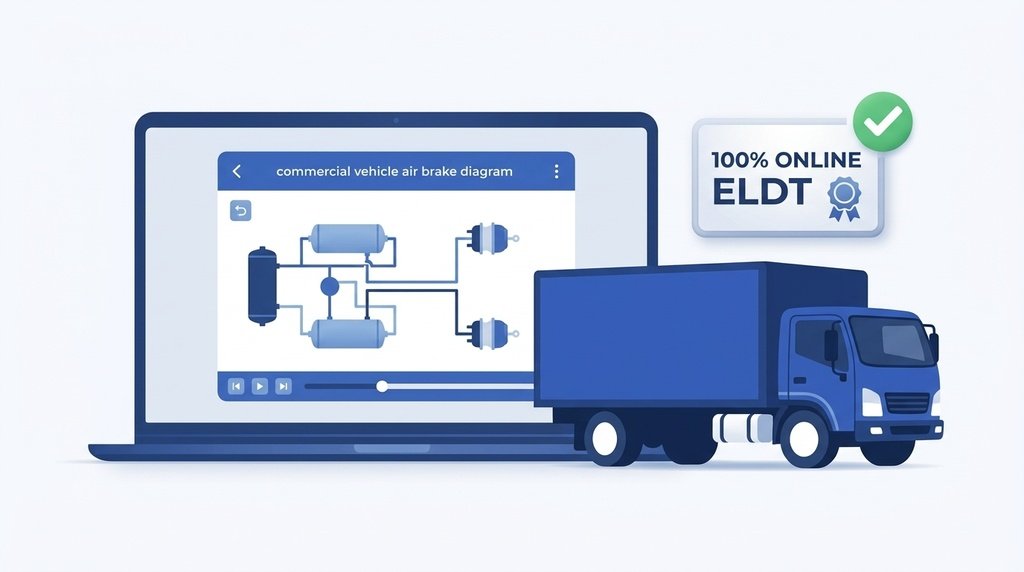
- 100% Online & Mobile Compatible: Complete lessons from your smartphone, tablet, laptop, or desktop computer. The platform is optimized for mobile studying during lunch breaks or between shifts.
- Self-Paced with Automatic Progress Saving: No mandatory seat-time clocks or rigid schedules. Log in and out whenever you want; your exact position saves automatically.
- Open-Book Section Reviews with Unlimited Retakes: Practice with multiple-choice questions modeling actual commercial testing. Unlimited retakes ensure you pass with confidence.
- Rapid Electronic TPR Submission: As soon as you pass, ETS transmits your completion record to the FMCSA TPR, clearing you to schedule your state exam without delays.
Popular Endorsements to Pair with Your Class B CDL
Expanding your Class B license with commercial endorsements significantly increases your job opportunities and earning power:
- Passenger (P) Endorsement: Qualifies you to drive motor coaches, airport shuttles, and municipal transit buses carrying 16 or more passengers.
- School Bus (S) Endorsement: Qualifies you to operate public and private school buses (requires a Passenger endorsement and additional federal background checks).
- Tanker (N) Endorsement: Allows you to drive single-unit vehicles transporting liquids or gases in tanks with an individual rated capacity greater than 119 gallons and an aggregate capacity of 1,000 gallons or more.
- Hazardous Materials (H) Endorsement: Unlocks high-paying opportunities delivering specialized chemicals, industrial gases, and fuel (requires specialized TSA fingerprint security threat assessment).
Conclusion
Obtaining your Class B Commercial Driver's License opens the door to high-demand, local driving careers in freight delivery, construction, waste management, and public transportation. By satisfying your mandatory FMCSA theory requirement online through an approved training provider, you avoid expensive classroom tuition, study at your own convenience, and fast-track your commercial driving credentials.
Enroll today, conquer your theory coursework from home, and take command of your future in commercial transportation.
ETS offers court-approved and FMCSA-registered online courses across all 50 states – 100% online, self-paced, with instant TPR reporting upon completion.
FAQs
Can I take the Class B ELDT theory course before getting my Commercial Learner's Permit (CLP)?
Yes. Federal regulations permit you to complete the online ELDT theory training either before or after obtaining your CLP. However, your theory completion must be recorded in the FMCSA Training Provider Registry before your state licensing agency will allow you to take the final CDL skills driving test.
Does completing online Class B ELDT satisfy the behind-the-wheel requirement?
No. The online course satisfies the federally mandated ELDT Theory (Classroom) requirement. Federal regulations require that Behind-The-Wheel (BTW) training covering range maneuvers and public road driving be completed in person with a certified commercial instructor in an actual Class B commercial vehicle.
How does the state DMV know that I finished my Class B ELDT course?
Upon passing your online course, ETS electronically transmits your completion records directly to the federal FMCSA Training Provider Registry (TPR). When you schedule or check in for your state CDL road exam, the state DMV examiner accesses the federal database to confirm your verified completion status.
How long does it take to complete the Class B ELDT theory course online?
The curriculum is self-paced and typically takes students between 15 to 30 hours to complete. Because there are no mandatory countdown timers or scheduled classes, you can study at your own speed—finishing in a few days of focused study or spreading modules over several weeks.
Can I upgrade from a Class B to a Class A CDL in the future?
Yes. If you decide to upgrade to a Class A license later, you will not have to repeat the entire curriculum. You will only need to complete a streamlined Class B to Class A upgrade course covering combination vehicle operations and coupling systems.


