California Speed Cameras Are Officially Live: Do Automated Tickets Add Points to Your DMV Record?

If you commute through Los Angeles, San Francisco, or the East Bay, you have probably noticed the new hardware going up near school crosswalks and high-injury transit corridors. Automated speed enforcement has officially arrived in California. Under Assembly Bill 645, six major cities have launched the state’s first automated speed safety camera pilot program—snapping photos of license plates and mailing civil violation notices straight to registered vehicle owners.
At ETS Traffic School, our instructors monitor California DMV regulations and court policies every week. As soon as the first speed camera housings went up on city poles, our phones started ringing with calls from worried commuters. The immediate question hitting driver forums and family group chats boils down to one thing: Does a ticket from a California speed camera put points on your DMV driving record and spike your car insurance rates?
The short answer is no—provided you understand how civil citations work under California Vehicle Code 22425. But ignore that envelope in the mail, or confuse an automated camera notice with an officer-issued citation on the highway, and you could easily find your vehicle registration suspended.
Here is our team's direct breakdown of how California’s AB 645 speed cameras operate, who gets ticketed, the fine tiers, and the vital difference between camera notices and moving violations that require traffic school.
Where Are the Speed Cameras Operating?
When we first examined Assembly Bill 645, our first thought was freeway speed traps. But you can breathe easy: we reviewed the statutory text, and you will not see these speed cameras along I-5, the 405, or US-101. California lawmakers explicitly banned automated speed cameras from all state highways and freeways.
Instead, we see six cities running a strictly bounded five-year pilot program:
- Los Angeles: Targeting designated High-Injury Network corridors, including stretches of Wilshire Boulevard, Figueroa Street, and high-risk school zones across the San Fernando Valley.
- San Francisco: 33 cameras going up on historic crash corridors like Geary Boulevard, Fulton Street, and Market Street.
- San Jose: High-speed arterials near public schools and transit hubs.
- Oakland: Key thoroughfares throughout East and West Oakland neighborhoods.
- Long Beach: High-collision corridors and coastal school perimeters.
- Glendale: School crosswalk routes and high-speed commuter routes off the Ventura Freeway.
Under the pilot rules, every participating city had to post clear warning signs before turning on the power, and they can only aim the cameras at school zones and streets with documented severe collision histories.
Do California Speed Camera Tickets Add Points to Your DMV Record?
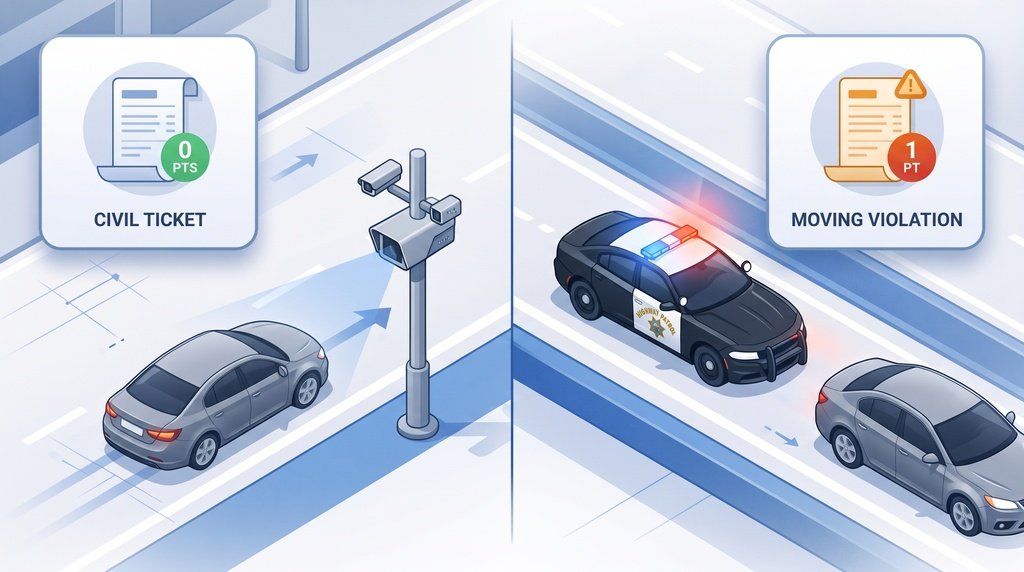
Let us get straight to the question we hear most: No, an automated speed camera ticket in California does not add points to your DMV driving record.
We checked Vehicle Code 22425(b), and the law classifies these camera citations strictly as civil infractions against the vehicle’s registered owner, not criminal offenses or moving traffic violations against your driver’s license.
Since the camera snaps a photograph only of your rear license plate and never captures the driver’s face, the city attaches the ticket to the car, not the person behind the wheel. That creates several huge protections for you:
- The California Department of Motor Vehicles (DMV) does not assign violation points to your driver's license.
- The city never reports the citation to your auto insurance carrier.
- Your insurance rates will not increase as a result of an automated camera flash.
- You never have to stand before a traffic court judge or plead guilty to a moving violation.
Think of an AB 645 camera ticket like getting a parking ticket on your windshield. You still have to pay the fine, but your driver's license record stays clean.
Speed Thresholds and Fine Tiers: How Much Does a Camera Ticket Cost?
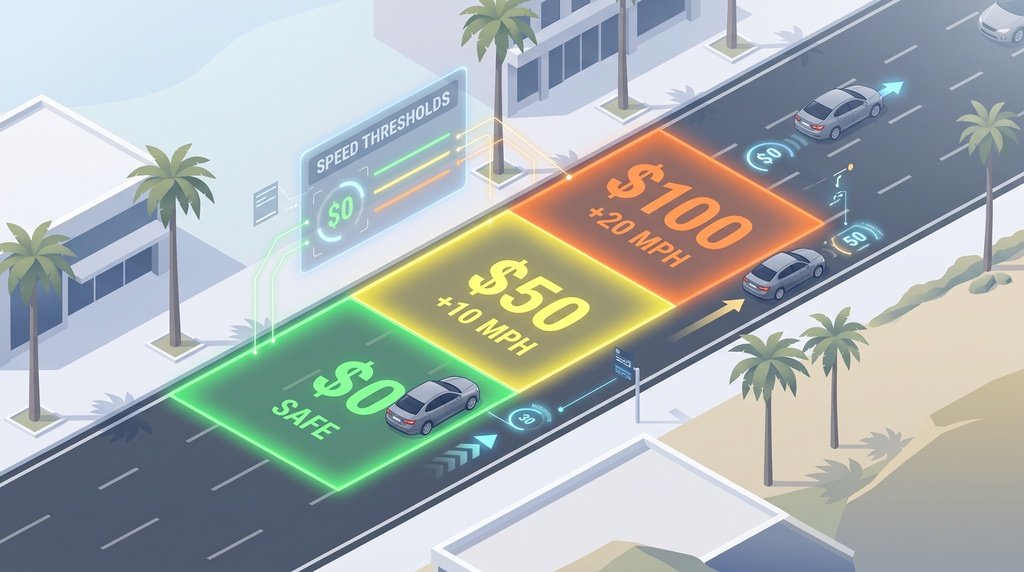
You won’t get a ticket for creeping 2 or 3 mph over the posted speed limit. To prevent predatory municipal speed traps, AB 645 establishes a strict statutory floor: cameras can only trigger if a vehicle exceeds the posted limit by at least 11 mph.
Once that 11 mph threshold is crossed, fines follow a set schedule:
| Speed Recorded Above Limit | Civil Penalty | Notes & Reductions |
|---|---|---|
| 1 to 10 mph over | $0 (No ticket) | Cameras are legally prohibited from triggering |
| 11 to 15 mph over | $50 | Base fine; drops to $10 for qualifying low-income drivers |
| 16 to 25 mph over | $100 | Drops to $20 for qualifying low-income drivers |
| 26 mph or more over | $200 | Severe urban speeding tier |
| 100+ mph (Extreme) | $500 | Maximum statutory civil penalty under AB 645 |
The 60-Day Grace Period
State law mandates that each participating city run a 60-day warning period when cameras first go live. If you get caught speeding during the initial 60 days of a camera’s operation, the city will mail a formal warning notice without assessing a financial penalty. Once that 60-day window expires, real fines apply.
Low-Income Protections
Unlike traditional traffic court fines that come bloated with hundreds of dollars in court administrative fees, AB 645 caps penalty amounts and includes mandatory poverty protections:
- Motorists earning at or below 250% of the federal poverty line qualify for an 80% fine reduction (dropping a $50 fine to just $10).
- Motorists earning between 250% and 400% of the federal poverty line qualify for a 50% fine reduction.
- All drivers can opt for community service instead of monetary payment.
What Happens If You Ignore an AB 645 Camera Ticket?
Since an automated camera ticket doesn’t carry DMV points, some drivers might feel tempted to toss the notice in the recycling bin. In our experience, that is an expensive mistake.
Although the city cannot dispatch police officers to arrest you or suspend your driver's license for unpaid civil penalties, AB 645 includes real collection powers:
- Escalating Late Fees: Failing to pay or contest the citation within the statutory window (usually 30 days) triggers administrative late penalties that can double the initial fine.
- Collections Agency Referral: Municipal finance offices will route unpaid debts to third-party collection agencies, damaging your credit score.
- DMV Registration Holds: If a citation remains unpaid, the ticketing city notifies the California DMV to place an administrative hold on your vehicle registration. When your annual renewal date arrives, the DMV will block your tags and refuse to issue your registration sticker until every cent of the fine and late fees is settled in full.
Driving with expired registration tags in California is a citable offense under CVC § 4000(a)(1), opening you up to roadside police stops and vehicle impoundment.
Camera Tickets vs. Officer Stops: When Do You Actually Need Traffic School?
Here is where so many California drivers get tripped up: automated speed cameras and real police traffic stops follow completely different legal playbooks.
If a California Highway Patrol (CHP) officer or local police officer pulls you over in person for speeding (under CVC § 22350 or CVC § 22349), that is not a civil citation. You just received an official moving traffic violation.
The Consequences of an Officer-Issued Ticket:
- 1 Point on Your DMV Record: A standard speeding ticket handed to you by a patrol officer adds 1 point to your California DMV driving record.
- Costly Insurance Hikes: That single point causes auto insurers to strip away your 20% "Good Driver Discount" under California Proposition 103, hiking your annual insurance premiums by $400 to $800 every year for 36 consecutive months.
- Suspension Risk: Collecting 4 points in 12 months, 6 points in 24 months, or 8 points in 36 months leads to license suspension under California’s Negligent Operator Treatment System (NOTS).
How to Mask an Officer-Issued Speeding Point
If a police officer handed you a paper ticket, simply paying the court fine will not protect your wallet. To keep your insurance rates low, you need to mask that violation by taking a state-licensed California Traffic Violator School (TVS) course.
When you finish an approved online traffic school program, the court masks the violation on your public record. Insurance companies cannot see the masked point, keeping your insurance premium right where it belongs.
Our team at ETS Traffic School provides the official, state-licensed California Traffic School Course Online ($27.99):
- California DMV Licensed (TVS #0000): Accepted by all 58 county superior courts across California.
- 100% Online & Mobile Friendly: Complete the lessons on your smartphone, tablet, or laptop whenever you have time.
- Electronic Court Submission: Once you complete the final quiz, our system transmits your certificate straight to your county court and the DMV electronically.
- Guaranteed Point Masking: Protect your Good Driver discount before your renewal rates take effect.
Can You Contest an Automated Speed Camera Ticket?
Yes. Just like a parking ticket, you have the right to fight a camera notice if the city made a mistake.
Under California AB 645, our team tracked three clear steps to dispute a ticket:
- First Administrative Review: Within 21 days of finding the notice in your mailbox, send a written dispute to the city agency. We tell drivers to include photos if speed limit signs were missing, or police reports if someone stole your car.
- Independent City Hearing: If the city turns down your first letter, you can ask for a hearing with an independent city hearing officer. You can present your side in person or mail in your written statement.
- County Court Appeal: If the hearing officer still sides with the city, you can take the dispute to your local county Superior Court within 30 days.
If someone stole your vehicle or if you already sold it before the date on the notice, send the city a copy of your police report or your DMV Notice of Transfer and Release of Liability (NRL). The city will dismiss the ticket on the spot.

Summary: What Every California Driver Needs to Remember
California’s automated speed safety program marks a big shift in urban traffic enforcement, but knowing the rules keeps you ahead of the game:
- 0 Points on Camera Tickets: Speed camera citations carry zero DMV points and cannot increase your insurance premiums.
- 11+ mph Trigger: Cameras only photograph vehicles going at least 11 mph over the speed limit.
- Pay on Time: Ignoring notices leads to DMV registration holds and collection fees.
- Officer Stops Still Require Traffic School: If a police officer hands you a speeding ticket in person, you must complete an approved course like ETS Traffic School to mask that 1 point from your driving record.
Frequently Asked Questions (FAQ)
Can California speed cameras take a picture of my face?
No. AB 645 explicitly forbids facial recognition technology and requires that photographic sensors capture only the rear license plate of the vehicle. Any image showing a driver's face cannot be used as legal evidence and must be permanently deleted from municipal files.
Will an AB 645 speed camera ticket increase my car insurance rates?
No. Since speed camera infractions are strictly civil penalties assigned to the registered vehicle owner, they are never sent to your DMV driver record. Insurance companies have no access to automated camera notices and cannot use them to change your premium rates or strip away good driver discounts.
Can I attend traffic school to dismiss an AB 645 speed camera citation?
No, and you don’t need to. California Traffic Violator School (TVS) is designed solely to mask moving violation points issued by the DMV. Since camera citations assess 0 DMV points, taking traffic school has no effect on the civil fine. If you get ticketed by an actual police officer, however, enrolling in ETS Traffic School is essential to keep that point off your record.
What happens if someone else was driving my car when the camera flashed?
Under AB 645, the registered owner remains legally responsible for the civil fine regardless of who was driving. You can ask the driver to pay you back, but the city will not transfer the ticket to a non-owner unless you prove the car was stolen or you had already sold it through an official DMV Notice of Transfer and Release of Liability.
Are speed cameras legal across the entire state of California?
No. AB 645 is a tightly bounded pilot program authorized strictly in six cities: Los Angeles, San Jose, San Francisco, Oakland, Long Beach, and Glendale. Automated speed cameras remain illegal on all California freeways and in every other California city unless lawmakers pass new state legislation.


